About Haworthia mirabilis (Haw.) Haw.
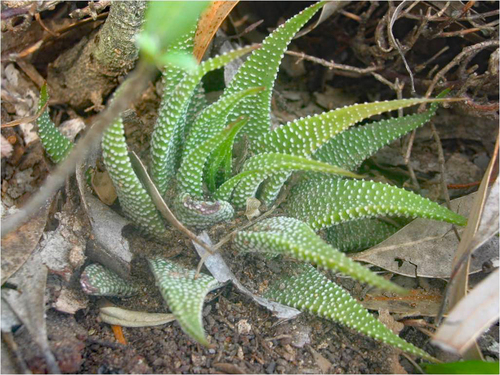
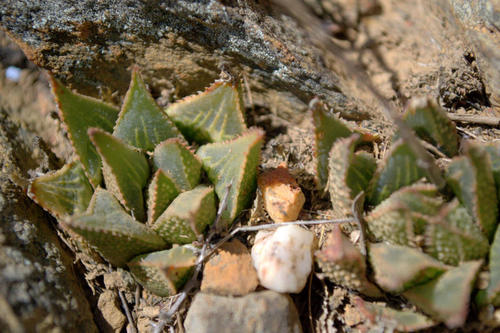
Haworthia mirabilis is an evergreen, slow-growing succulent species that reaches 4 to 45 centimetres (1.6 to 17.7 in) in height. It is usually a solitary, stemless plant. Its leaves are green, with pale green longitudinal lines along their upper surfaces and small teeth along the margins. Leaves turn brownish or reddish when exposed to sun, and grow in a rosette. The small white flowers are borne in an inflorescence.
This is a highly variable species, and one of the "retuse" species of Haworthia. This means it usually grows sunken beneath the ground, with only its flattened leaves visible at the ground surface. Its rosette of succulent leaves is curved back (retuse) to form a flat, level face at the ground surface. In this growth form, it resembles other retuse haworthias, such as Haworthia pygmaea, Haworthia bayeri, Haworthia springbokvlakensis, Haworthia magnifica, Haworthia emelyae and Haworthia retusa. However, Haworthia mirabilis can be distinguished from these relatives by the marginal bristles on its leaves, the sharp points at the tips of its leaves, and it usually also has lines on the upper surfaces of its leaves.
This species is native to the Western Cape, South Africa. It occurs specifically in the Overberg District, near the far southern point of the country. It grows in rocky areas, especially on slopes or ridges, at an altitude of approximately 500 meters. In its natural habitat, it is often found growing in partial shelter provided by bushes or shrubs.