About Hatiora salicornoides (Haw.) Britton & Rose
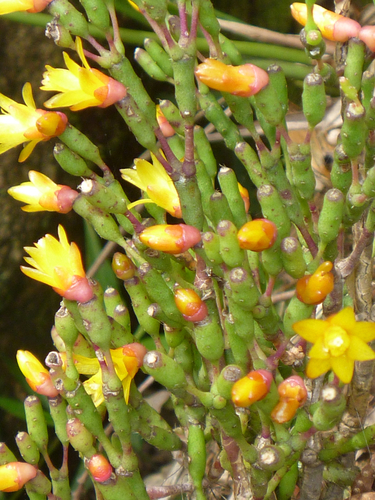
Hatiora salicornoides (Haw.) Britton & Rose grows to around 1 meter (3 feet) tall, with an erect to pendent growth habit. Its stems are made of segments measuring 1.5–5 cm (0.6–2.0 in) long. Each segment is club or bottle-shaped, with its narrower end at the base. Stems branch from the end of a segment, forming whorls of up to six branches. Yellow to orange flowers grow at the ends of younger stem segments; these flowers are 1–2 cm (0.4–0.8 in) long, and are approximately the same width when fully open. After flowering, the plant produces translucent white berries. This species occurs along the coast and slightly inland in southeastern Brazil, in states running parallel to the Atlantic Ocean. It is not typically found growing directly at sea level, and is most commonly recorded from the states of Bahia, Espírito Santo, Minas Gerais, Rio de Janeiro, São Paulo and Paraná. Documented locations include the cities and municipalities of Belo Horizonte, Curitiba, São José dos Pinhais, and Tiradentes, among others; it also grows naturally in and around the metro areas of Rio de Janeiro and São Paulo, where it occurs among tall trees, in parks, and in landscaped areas. A number of large botanic gardens and national parks lie near or within the city limits of Rio de Janeiro and São Paulo, including Tijuca National Park and the Rio de Janeiro Botanical Garden. These protected areas provide natural habitat for this delicate epiphytic cactus even within two of the world’s most densely populated megacities. This species is part of the flora of the Atlantic Forest (Mata Atlantico), the large, fragile forested ecoregion along southeastern Brazil’s coastline. This ecoregion holds dense, relatively intact forest habitat rich in endemic plants and animals, including multiple Hatiora species and other jungle cacti. The region’s high plant growth rate and large number of unique species are linked to stable ambient humidity and relatively consistent equatorial temperatures, as well as regular precipitation and thunderstorms. Plants here also gain extra humidity from fog, marine layers, and morning dew. The region holds many rivers and streams; along these waterways, dozens of epiphytic species grow on tree branches directly above the water, gaining benefit from the ambient humidity and cooling breezes produced by the fast-flowing water. Across Atlantic forests and most forested regions of Brazil, epiphytic cacti are most commonly found on tree limbs. Hatiora species may grow on very high branches, closer to the forest floor, or in unexpected locations anywhere on a host tree. Hatiora plants grow and become established wherever their dispersed seeds sprout, or where broken vegetative segments or cuttings land on a new tree branch and take root. Asexual vegetative reproduction is usually the fastest way for epiphytic cactus species to spread and colonize new areas. These plants use trees, boulders, logs, or other natural objects as permanent growing structures. In Brazilian forests, individual trees often host diverse communities of arboreal cacti growing alongside epiphytes from other plant groups, including Araceae, Bromeliaceae, ferns, mosses, Orchidaceae, Peperomia, Tradescantia, and more. In these productive rainforests, every available growing space is used, giving plant-covered trees an almost dripping appearance. Along with most of these other epiphyte types, Hatiora produces sticky-tipped aerial roots from root nodes or internodes (the sections of stem where leaves attach) to anchor the plant to textured tree bark. Once anchored, the plant grows slowly, gradually moving toward sunlight. In addition to thriving in moist forest, this small cactus also grows on trees in more open savanna habitats, rocky outcrops, humid canyons, and montane regions. It occurs at elevations ranging from 200 to 1,750 m (660 to 5,740 ft). It is almost never found rooted in the ground, and nearly always grows as an epiphyte on trees or as a lithophyte on rock. Hatiora salicornoides is cultivated as an ornamental plant. It needs some humidity and cannot tolerate frost. It is recommended to grow it in light shade with a minimum average temperature of 12 °C (54 °F). When these conditions are met, it can be successfully grown outdoors in Phoenix, Arizona. In climates with colder winter temperatures, it is grown in greenhouses or kept as a house plant. It is propagated by stem cuttings. In the United Kingdom, Hatiora salicornoides has received the Royal Horticultural Society's Award of Garden Merit.