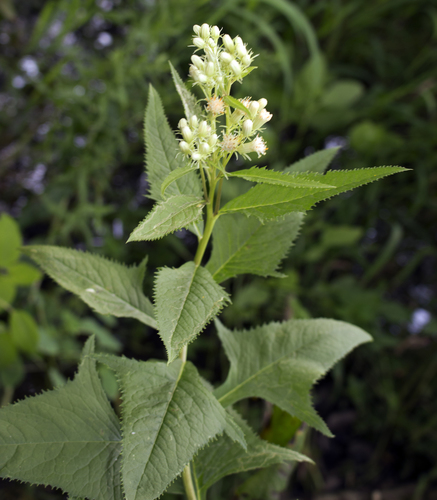
About Hasteola suaveolens (L.) Pojark.
Hasteola suaveolens (L.) Pojark. is a perennial herb that can reach up to 240 cm (8 feet) in height. It is completely hairless, and does not branch below its inflorescence. Its leaves are spearhead-shaped (hastate), 10 to 25 cm (4 to 10 inches) long, 5 to 15 cm (2 to 6 inches) wide, and have serrated, toothed edges. This plant flowers in late summer or early fall. Its inflorescence forms one or several roughly flat-topped clusters holding several to many flower heads. Each flower head is made up entirely of 18–55 white or very pale yellow disc florets, with no ray florets. The fruit it produces is a cypsela with a pappus of white bristles. This species is native to eastern and central USA, with a native range covering twenty-two states east of the Mississippi River and two states west of the Mississippi River. It is listed as an endangered species in Connecticut, Maryland, Minnesota, and New York; listed as threatened in Iowa and Tennessee; and listed as historical in Rhode Island, meaning it is presumed extirpated there. Hasteola suaveolens is now less common or completely absent across the northern portion of its native range. Only one population of the species may remain in all of New England. In Virginia, it grows in floodplain forest and riverbank habitats along the Potomac, Shenandoah, and New rivers. The species relies on the presence of appropriate suitable habitat to survive. It can be eliminated from a region by development, changes in land use, or competition with invasive species. In Minnesota, its original native habitat is wet meadows along stream banks and marsh edges, but due to extensive loss of this habitat, the species may now be restricted to growing in wet ditches.