About Hasora chromus (Cramer, 1780)
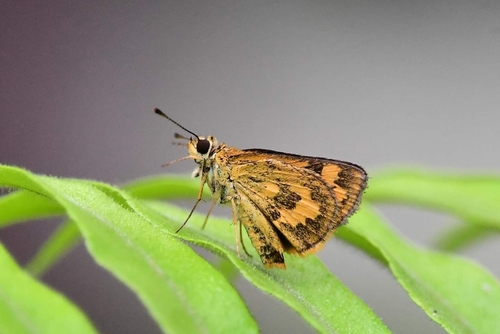
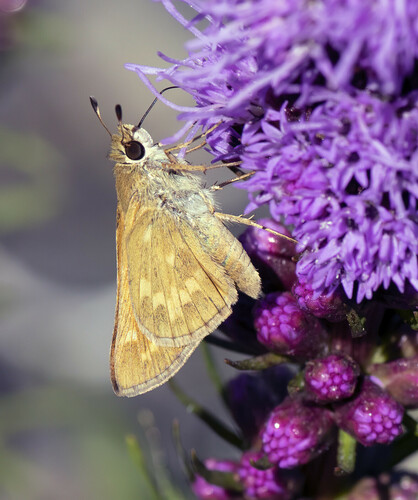
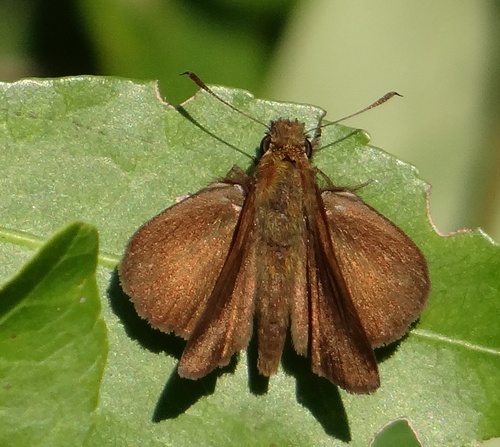
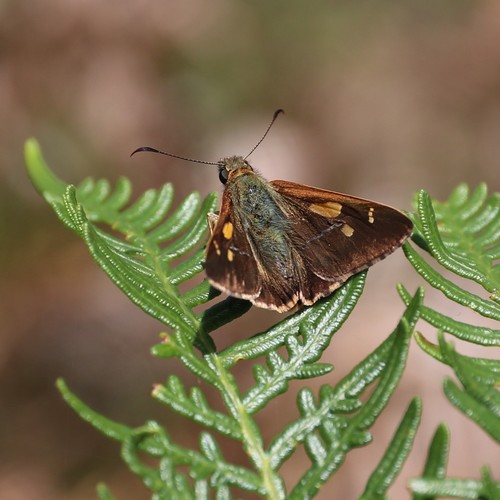
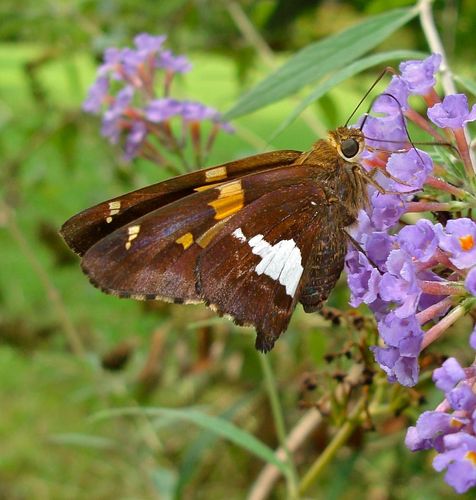
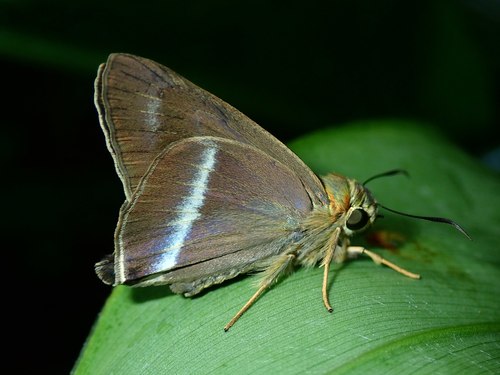
Hasora chromus, commonly known as the common banded awl, has a wingspan of 45–50 mm for both males and females. Both sexes are dark vinaceous brown, which matches the colour of red wine. Their cilia are greyish brown, while the head and thorax are greenish brown. The abdomen, third joint of the palpi, and legs are brown; the underside of the palpi and thorax is dull yellow. On the underside of the hindwing, the base colour is dark brown with a more or less prominent dull blue-grey gloss. The hindwing has a narrow, whitish discal band that is diffused along its outer margin, and a black tornal patch. This black spot is only clearly visible for a few moments right after the butterfly hatches, and very soon becomes hidden in the hindwing fold, a characteristic trait of this genus. The spot can also be observed in mounted museum specimens. Males are dark brown and unmarked on their upper side; the forewing upperside bears a brand extending from vein 1 to vein 4. Females have two yellowish-white discal spots on their upper side, plus a small spot near the wing apex. The common banded awl is distributed across the entire Indian subcontinent, Southeast Asia including the Malay Peninsula and the Indonesian archipelago, South China, Okinawa (Japan), the United Arab Emirates, Papua New Guinea, and Australia. It occurs in both plains and hilly areas up to 2,100 m (7,000 feet), and can be found in jungle and open country across regions with both light and heavy rainfall. During its life cycle, females lay eggs singly on young shoots or new leaves, on both the upper and lower leaf surfaces. Freshly laid eggs are pinkish white, dome-shaped with a flattened top, and covered in tiny longitudinal ridges. These ridges have a bead pattern with fine transverse striations, and eggs turn dirty white as they mature. The caterpillar is cylindriform, with a constricted second segment that forms a neck marked by a black collar. Its head is lobed, rounded, and yellowish-red. The caterpillar's body is yellowish-black with brown sides that can range from pale to dark brown; its markings are very variable. The underside of the caterpillar is greenish white tinged with yellow, and sometimes the greenish colour covers the entire body along with the dark markings. When newly hatched, the caterpillar eats most but not all of its egg shelf, then scurries to a leaf and quickly builds a protective cell for itself. Young caterpillars are active, but become lethargic as they grow, and only venture out to feed during periods of very low light, at night. The pupa is stout and pale brown, with a white abdomen and a prominent projection on the head between the bulbous eyes. Larvae of this species have been recorded feeding on the host plants Ricinus communis, Derris scandens, Pongamia pinnata, Heynea trijuga, and Toddalia asiatica.