About Hasora badra (Moore, 1857)
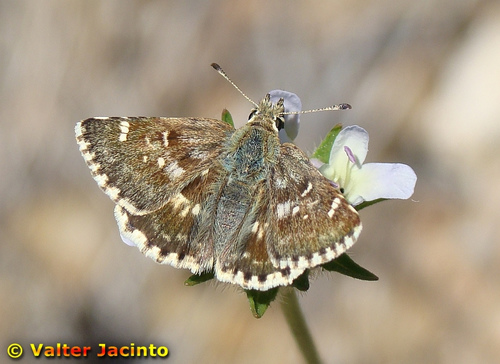
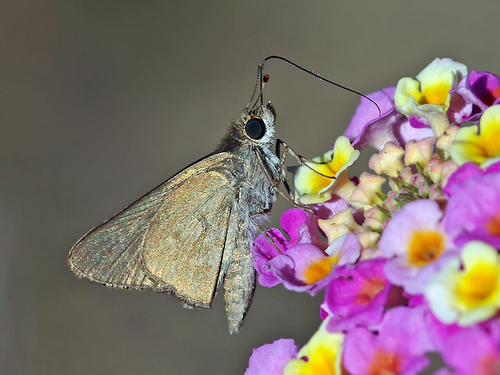
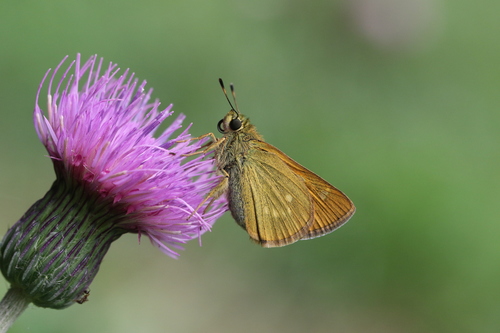
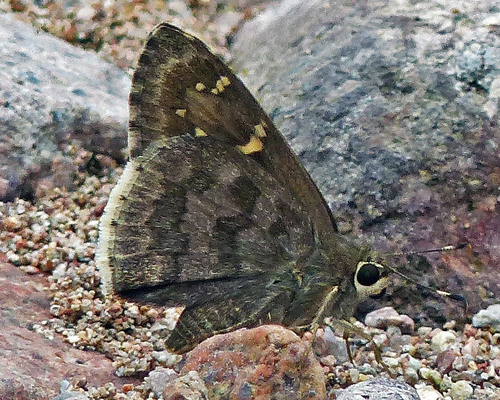
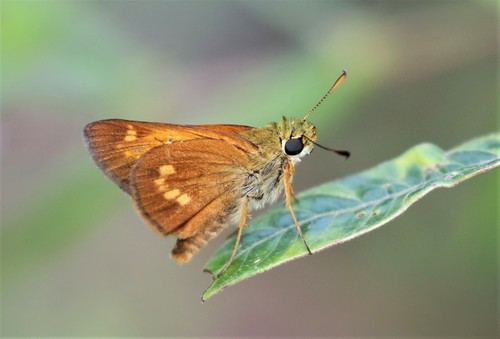
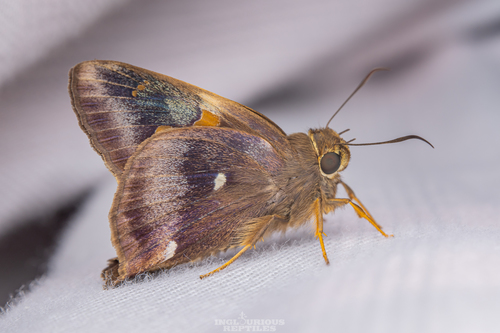
Hasora badra, first described by Moore in 1857, is a butterfly species with a typical wingspan of 50 to 55 mm. The upperside of adults is unmarked dark brown. It closely resembles the related common banded awl Hasora chromus, but differs by lacking a white band on the underside; additionally, the forewing apex and the underside hindwing disc have a purple wash. Males have apical spots on the upperside, but no brands, while females have large yellow spots in cells 2 and 3, plus small apical dots. The Sri Lankan race of Hasora badra lacks male apical spots on the upperside and also lacks the purple wash on the underside. A detailed description published by Edward Yerbury Watson in 1891 notes that both sexes are yellowish brown overall. For males, there is a suffused blackish subbasal patch; the forewing has three connected very small, yellowish, semitransparent spots near the costa, positioned one quarter of the wing length from the apex. Cilia are pale greyish brown. The underside is brown suffused with purple; the forewing has a blackish costal patch before the apex, with a yellowish posterior margin. The hindwing has a suffused blackish subbasal band and a suffused blackish submarginal band, with the submarginal band ending in a black patch on the anal lobe. Above this black patch is a purple-white streak, and there is a small bluish white spot within the cell. Palpi and the underside of the body are dull yellow, while legs are pale brown. For females, the upperside is brown, with the basal area suffused with vinaceous yellowish brown. The forewing has the same three small subapical spots as the male, plus three rather large, obliquely quadrate spots: two on the disc, and a third above and within the cell. The underside matches the upperside for forewing spots, and the hindwing matches the male hindwing pattern. This species occurs across South, East, and Southeast Asia. Its recorded distribution includes Sri Lanka, India, Myanmar, Thailand, Laos, Hainan, Taiwan, northern Vietnam, Japan, western China, Malaysia, the Indonesian archipelago (Borneo, Sumatra, Java), the Philippines, Palawan, the Moluccas, and Sulawesi. Within India, it is found in South India in the Western Ghats and the Nilgiris; it also occurs in the Himalayas from Mussoorie eastwards to Sikkim, continuing through to Myanmar, and is present in the Andaman Islands and Nicobar Islands. The type locality for Hasora badra is Java, Indonesia.