About Hasora anura de Nicéville, 1889
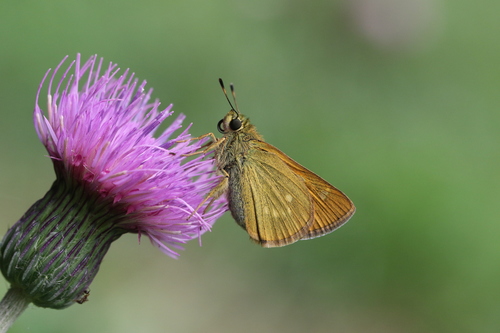
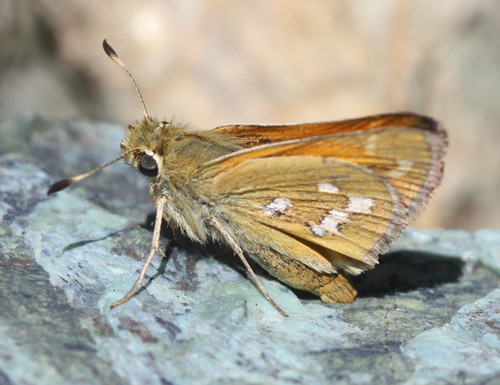
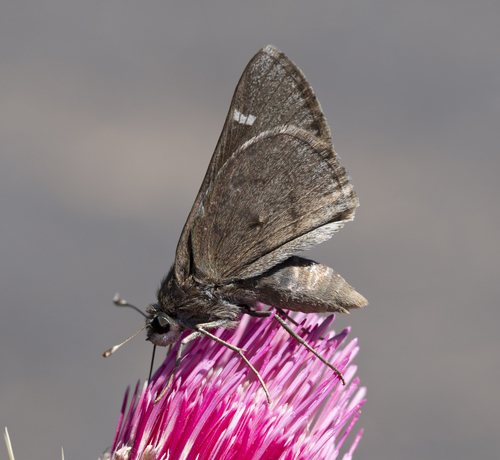
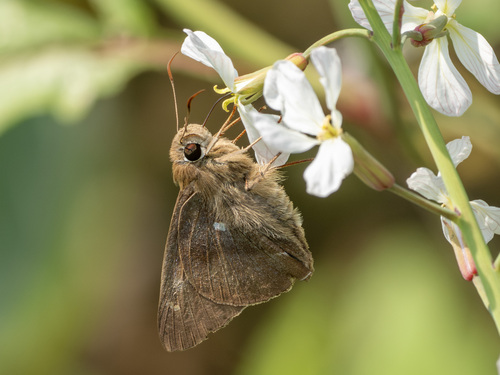
Edward Yerbury Watson published a detailed description of Hasora anura de Nicéville, 1889 in 1891, which is reproduced below. For males: The upperside of both wings is a deep bronzy-brown, with the base and disc thickly covered in long ochreous-brown hairs, and ochreous-brown cilia. The forewing has a minute, transparent, shining yellow subapical dot. On the underside, both wings are dark brown with a slight purple gloss. The forewing has a broadly pale inner margin and a broad discal dark band that lacks purple gloss. For the male hindwing, the basal two-thirds are much darker than the outer third, with a clearly defined boundary between the two regions. On the dividing edge toward the abdominal margin, there is a small, prominent ochreous spot. There is also an ochreous anteciliary line running from the anal angle to the first median nervule; in one specimen, both the ochreous spot and line are obscure. A prominent whitish spot in the middle of the disc is present in one specimen and obscure in the other. For females: The upperside of both wings is the same color as that of males. The female forewing has a quadrate spot at the end of the cell, and an elongated spot below it across the first median interspace, which has a straight inner edge and a concave outer edge. There is an additional smaller narrow spot, constricted in the middle, across the middle of the second median interspace, plus three increasing-sized subapical dots. All of these spots are shining, translucent, rich ochreous. On the underside, the forewing shows the spots from the upperside through its surface, and has a broadly bright ochreous inner margin; it is otherwise identical to the male underside. This species is closely related to the common Hasora badra Moore, but differs from H. badra in both sexes by lacking a large anal lobe on the hindwing. H. badra has this anal lobe, which is colored black on the underside, and there is no trace of this black patch in H. anura. H. anura is also a smaller insect than H. badra. For females, the three large discal yellow spots on the forewing of H. anura are considerably smaller and of a deeper, richer yellow than those of H. badra. In terms of distribution, within Asia this butterfly occurs from Mussoorie eastward to Sikkim India, the Shan states of Myanmar, Thailand, and southwestern and central China (Yunnan). The type locality of the species is Sikkim.