About Harungana madagascariensis Poir.
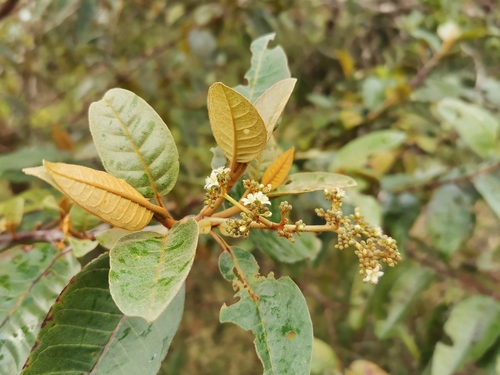
Harungana madagascariensis, commonly called haronga, is a small bushy tree that typically reaches 4 to 7 meters in height, though it may occasionally grow as tall as 25 meters. Its branches grow from a cylindrical trunk, with an angular, forked bole and a golden-green crown. The maroon-colored bark is vertically fissured; its vertically arranged scales flake off easily. When the stem is peeled, leaves snapped off, branches broken, or bark damaged, this tree exudes a characteristic almost fluorescent orange latex. Most of the tree's surface is covered in stellate hairs. Its leaves are opposite, simple, and ovate, with leaf blades measuring 6 to 20 centimeters long by 3 to 10 centimeters wide. Leaves are glossy on the upper surface; the underside is covered in stellate hairs or scales, dense rusty hair, and prominent, numerous lateral veins. Young leaves have a distinctive brown lower surface. Leaf apexes taper, and petioles are 1.5 to 3 centimeters long. Flowers are small, around 5 to 6 millimeters across, bisexual, and white or cream-colored, with an almond scent. Sepals are marked with dark red-brown dots. Stamens are fused into five bundles, which usually hold two or three stamens each, though single stamens occur occasionally. The ovary has dark glandular spots, and flower stalks and calyx are covered in short rusty hairs. Flowering occurs from January to April in Southern Africa, with fruiting lasting until October; in Sierra Leone, flowering begins in May, peaks in August and September, and tapers off around December. Fruits are small, around 3 millimeters in diameter, roughly globular, berry-like drupes. They start greenish-orange and turn red when mature, with a persistent calyx. Fruits are marked with glandular dots and streaks, and have a hard endocarp that is difficult to cut. This fruit is not edible and has no known apparent use. The species' cotyledons are broadly spathulate, with margins marked by dark 'oil' glands, and relatively long, slender petioles. At the tenth leaf stage, the 'oil' glands are very dark, visible in transmitted light and on the underside of the leaf blade. Seeds of this species are susceptible to insect attack.