About Harpyhaliaetus coronatus (Vieillot, 1817)
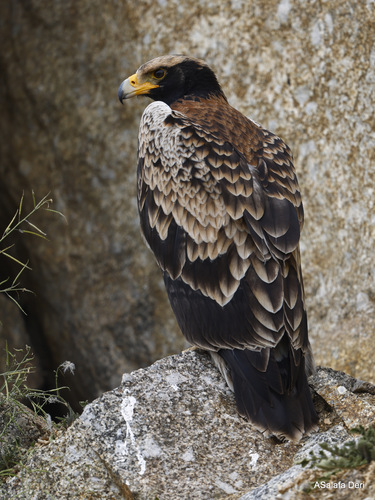
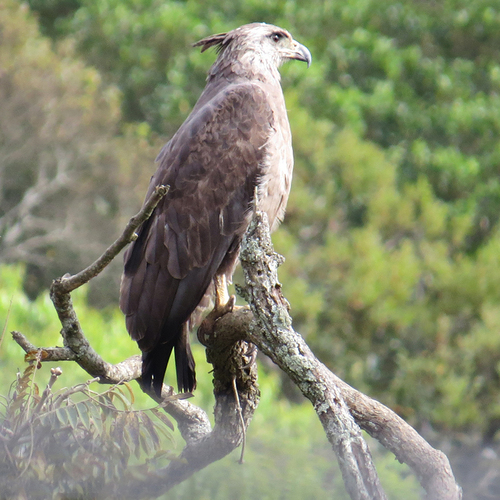
The Chaco eagle, also called the crowned solitary eagle, has the scientific name Harpyhaliaetus coronatus (Vieillot, 1817). It is a large raptor with mostly dull silvery grey body plumage. Its short black tail features a broad white medial band and a white tip, and both its cere and legs are yellow. As its alternative name suggests, it has a crest of darker grey feathers. Juveniles also have a crest, but their plumage is primarily dark brown, with the exception of a creamy head and underbody that both carry grey streaks. It is one of the largest raptors in the Neotropics, typically weighing around 2.95 kg (6.5 lb). Its total body length ranges from 73 to 79 cm (29 to 31 in), and its wingspan ranges from 170 to 183 cm (5 ft 7 in to 6 ft 0 in). This bird is endemic to central and eastern South America, where it occurs in central and southern Brazil, Bolivia, Paraguay, and Argentina as far south as northern Patagonia. Its status in Uruguay is uncertain; it has not been seen there for decades and is believed to be extinct there. It has undergone regional extinction in parts of its former range, and occurs at very low densities across its entire current range. This makes it one of the rarest and most threatened raptors in the Neotropical region. Only 250 to 999 mature individuals remain, and the total population of the species is between 375 and 1499 individual birds. The Chaco eagle inhabits semi-open habitats including open mixed grasslands, brushlands, savannahs, marshes, and open woodlands. Large trees are a critical feature of its habitat, as the species uses them for nesting. The Chaco eagle is a monogamous species. Between August and October, females lay a single white egg marked with grey spots into a platform-like nest built from sticks and leaves. The nest is constructed on the tallest trees within the species' breeding territories, 10 to 13 meters above ground. Some eagles have been observed nesting on human-made buildings in areas where no suitable trees are available. The egg hatches roughly 45 days after being laid, usually between November and December. From the time the egg is laid, the female stays near her offspring until the chick is old enough to be left alone for short periods. The male continuously brings food back to the nest, and the female begins joining hunting once the chick hatches and grows somewhat. Offspring remain in the nest for 65 to 70 days after hatching. Little is known about the age at which this species reaches breeding maturity, but it is estimated that individuals do not begin breeding before they are 3 to 5 years old.