About Harpia harpyja (Linnaeus, 1758)
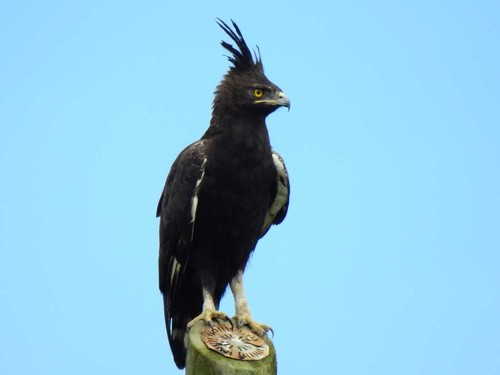
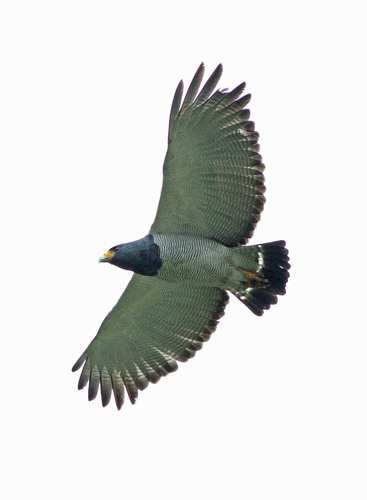
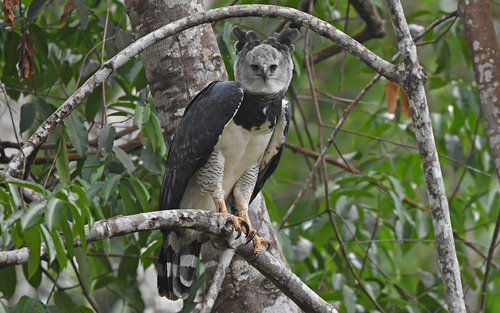
This description covers the harpy eagle, whose scientific name is Harpia harpyja (Linnaeus, 1758). The upperside of the harpy eagle is covered with slate-black feathers, while the underside is mostly white. The only exception is the feathered tarsi, which are striped black. A broad black band across the upper breast separates the gray head from the white belly. The head is pale grey and crowned with a double crest. The upperside of the tail is black with three gray bands, while the underside of the tail is black with three white bands. Irises can be gray, brown, or red; the cere and bill are black or blackish, and the tarsi and toes are yellow. The plumage of males and females is identical. The tarsus can reach up to 13 cm (5.1 in) long. Female harpy eagles typically weigh 6 to 9 kg (13 to 20 lb). One source notes that adult females can weigh as much as 10 kg (22 lb). An exceptionally large captive female named "Jezebel" weighed 12.3 kg (27 lb). Because this individual is captive, its weight may not be representative of wild harpy eagles, due to differences in food availability between captive and wild environments. Males are much smaller by comparison, with a weight range of 4 to 6 kg (8.8 to 13.2 lb). Reported average weights are 4.4 to 4.8 kg (9.7 to 10.6 lb) for adult males, and 7.3 to 8.3 kg (16 to 18 lb) for adult females, meaning the difference in mean body mass between the sexes is 35% or higher. Harpy eagles have a total length ranging from 86.5 to 107 cm (34.1 to 42.1 in), and a wingspan of 176 to 224 cm (69 to 88 in). Standard body measurements are as follows: wing chord 54–63 cm (21–25 in), tail 37–42 cm (15–17 in), tarsus 11.4–13 cm (4.5–5.1 in) long, and exposed culmen from the cere (the beak) 4.2 to 6.5 cm (1.7 to 2.6 in). Mean talon size is 8.6 cm (3.4 in) in males, and 12.3 cm (4.8 in) in females. The harpy eagle is sometimes cited as one of the largest extant eagles, alongside the Philippine eagle and Steller's sea eagle. The Philippine eagle is somewhat longer on average, with a between-sex average of 100 cm (39 in), but weighs slightly less. Steller's sea eagle is perhaps slightly heavier on average, with a mean weight of 7.75 kg (17.1 lb) from three unsexed birds. The harpy eagle may be the largest bird species residing in Central America, though large water birds such as American white pelicans (Pelecanus erythrorhynchos) and jabirus (Jabiru mycteria) have scarcely lower mean body masses. The harpy eagle's wingspan is relatively small, even though the wings themselves are quite broad. This is an adaptation that improves maneuverability in forested habitats, a trait shared by other raptors that live in similar habitats. Several large eagles that live in more open habitats, such as those in the Haliaeetus and Aquila genera, have larger wingspans than the harpy eagle. The extinct Haast's eagle was significantly larger than all living eagles, including the harpy eagle. This species is largely silent when it is away from the nest. At the nest, adult harpy eagles produce a penetrating, weak, melancholy scream. The call of an incubating male is described as "whispy screaming or wailing". Incubating females have similar calls, but theirs are lower-pitched. When a male approaches the nest carrying food, it gives "rapid chirps, goose-like calls, and occasional sharp screams". Vocalization from both parents decreases as nestlings get older, while nestlings become more vocal. Nestlings give a repeated chi-chi-chi call, seemingly as an alarm response to rain or direct sunlight. When humans approach the nest, nestlings have been described making croaks, quacks, and whistles. Relatively rare and elusive across its entire range, the harpy eagle is found from southern Mexico, which includes the states of Chiapas, Oaxaca, and the Yucatán, south through Central America, and into South America as far south as Argentina. Tourists and locals can still see the species in Costa Rica and Panama. Harpy eagles prefer rainforest as their habitat, and they nest and hunt predominantly in the emergent layer. The eagle is most common in Brazil, where it is found across the entire country. With the exception of some areas of the aforementioned Panama and Costa Rica, the species is nearly extinct in Central America. This is likely due to the logging industry decimating much of the Meso-American rainforests. Climate change is expected to cause further decline in the species' suitable habitat. The harpy eagle prefers tropical, lowland rainforests, and may also choose to nest within these areas anywhere from the canopy to emergent vegetation. They typically occur below an elevation of 900 m (3,000 ft), but have been recorded at elevations as high as 2,000 m (6,600 ft). Within forests, they hunt in the canopy or, rarely, on the ground, and perch on emergent trees to scout for prey. They do not generally occur in disturbed areas, and avoid humans whenever possible, but they regularly make hunting forays into semi-open forest and pasture mosaic. However, harpy eagles can be found flying over forest borders in a variety of habitats, such as cerrados, caatingas, buriti palm stands, cultivated fields, and cities. They have recently been found in areas where high-grade forestry is practiced.