About Harpagus diodon (Temminck, 1823)
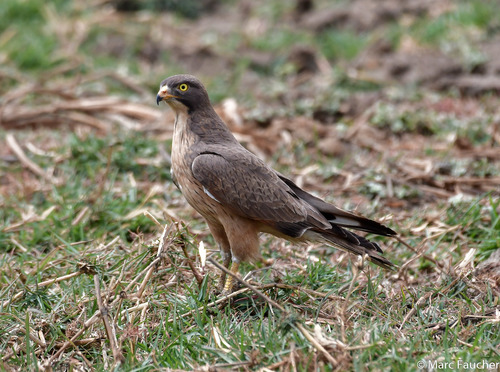
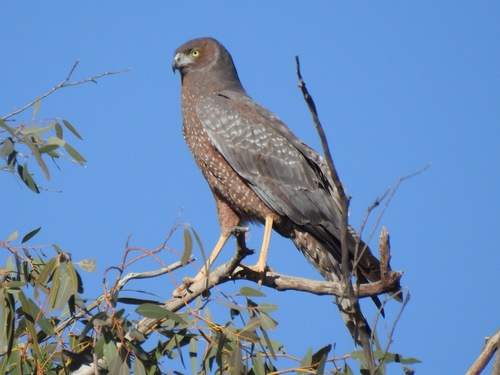
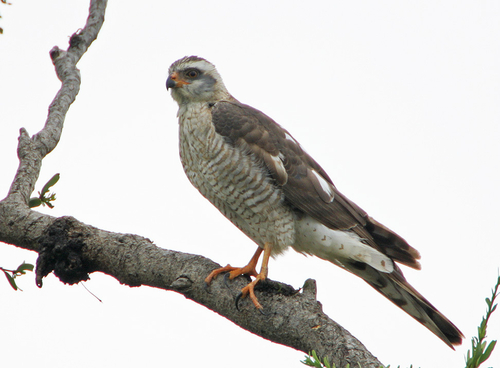
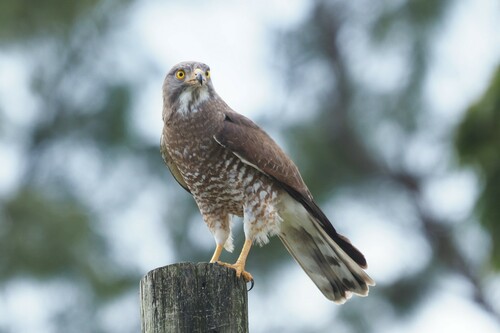
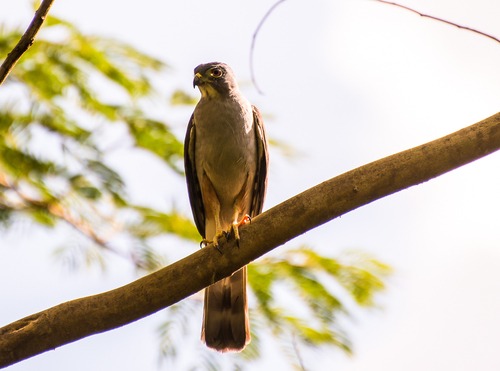
The rufous-thighed kite, scientific name Harpagus diodon (Temminck, 1823), measures 29 to 35 cm (11 to 14 in) in length, with a wingspan of 60 to 70 cm (24 to 28 in). The sexes are almost identical in appearance, though the female is slightly larger than the male. Chestnut-colored thighs give this species its common English name. Adult rufous-thighed kites have a slate gray head and upperparts. Their tail is slate gray with three paler gray bars, and the tips of the tail feathers are white. Their throat is whitish with a dark streak running down its center. Their breast is gray, which fades to white at the undertail coverts. Their eye is red or orange, their cere is lemon yellow, and their legs are yellow to orange. Immature birds have dark brown upperparts with streaks on the side of the head; they are whitish on the underside, with some darker streaking on the breast and belly, and barring on the flanks. The rufous-thighed kite breeds in southern Brazil, northern Argentina, and Paraguay. During the non-breeding season, it is regularly found further north in Amazonian Brazil, Bolivia, Guyana, and Suriname. The South American Classification Committee of the American Ornithological Society (SACC) has documented records of the species vagrancy to French Guiana and Venezuela, but has not evaluated a report of the species from Colombia. The SACC also classes the rufous-thighed kite as hypothetical in Ecuador, based on an undocumented sight record. The rufous-thighed kite primarily inhabits lowland rainforest. It favors primary forest, but can also be found in sufficiently aged secondary forest that has developed a closed canopy. It has been observed in both dense and more open forests, and was even recorded once in a forest patch within the city of São Paulo, Brazil.