About Harpagus bidentatus (Latham, 1790)
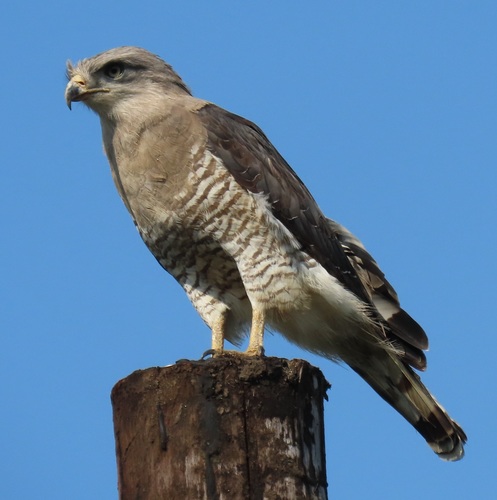
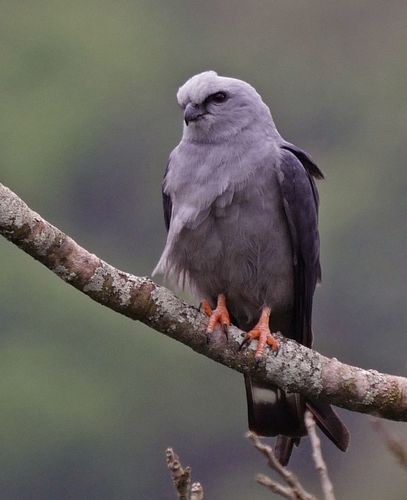
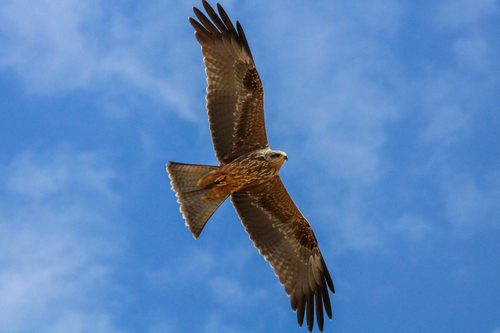
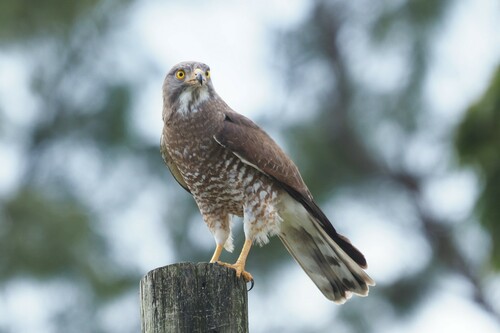
Harpagus bidentatus, commonly called the double-toothed kite, measures 29 to 35 cm (11 to 14 in) in length, with a wingspan ranging from 60 to 72 cm (24 to 28 in). Males weigh approximately 160 to 200 g (5.6 to 7.1 oz), while females weigh 190 to 230 g (6.7 to 8.1 oz). The species gets its common English name from the tooth-like notches along the edge of its upper bill, or maxilla. Males and females have similar plumage patterns, though females have richer coloration than males.
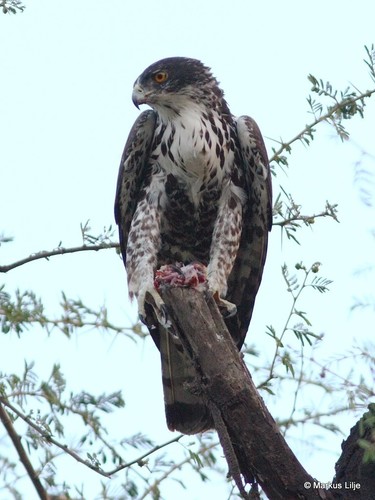
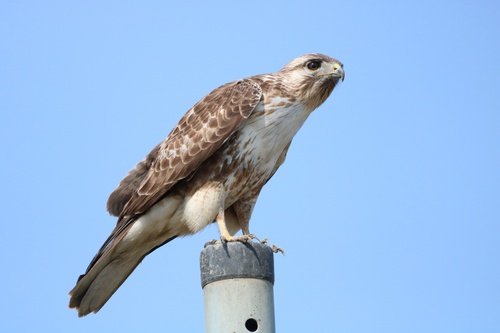
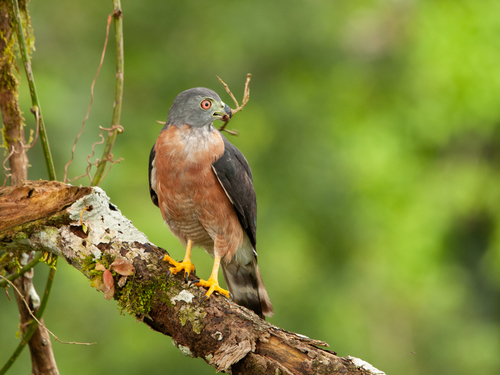
Adults of both recognized subspecies have a dark gray head and a white throat with a dark central stripe. Their upperparts are a somewhat lighter gray, and their tails are blackish, marked with three grayish bands and a gray tip. Their eyes are red, their cere is greenish yellow, and their legs and feet are yellow. The nominate subspecies has a rufous breast, a rufous belly with gray and whitish barring that sometimes extends into the lower breast, and white undertail coverts. Adult individuals of the subspecies H. b. fasciatus have underparts similar to the nominate subspecies, but their rufous coloration is paler and less extensive, while their barring is heavier and covers more area. Immatures of both subspecies have deep brown upperparts and whitish to buff underparts marked with bold vertical brown streaks.
The two subspecies have separate ranges, with the nominate subspecies occupying the more southerly distribution. The nominate subspecies occurs on Trinidad, starting from eastern Colombia extending east through Venezuela and the Guianas, and south and east into Amazonian Ecuador, Peru, Bolivia, and Brazil, with an additional separate population in southeastern Brazil. Subspecies H. b. fasciatus ranges from Jalisco and southern Veracruz in Mexico, through the Caribbean slopes of Guatemala, Belize, and Honduras, and along both slopes of Nicaragua, Costa Rica, and Panama, continuing into western Colombia and western Ecuador. One individual has been recorded as a vagrant in Texas.
The double-toothed kite primarily lives in the interior of mature subtropical and tropical forest. It is found less often in forest edges and clearings, young secondary forest, scrubby woodland, and disturbed forest. In terms of elevation, the species occurs from sea level up to at least 1,200 m (3,900 ft) in Costa Rica, around 1,200 m (3,900 ft) in Colombia, and as high as 2,100 m (6,900 ft) in Ecuador.