About Harmonia axyridis (Pallas, 1773)
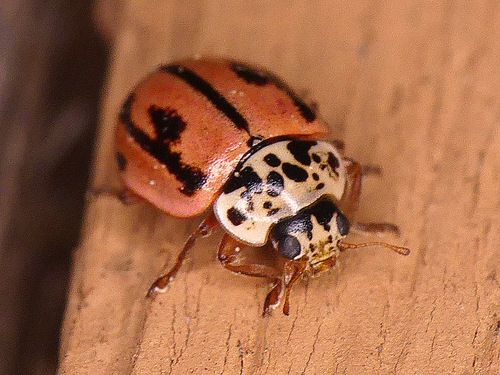
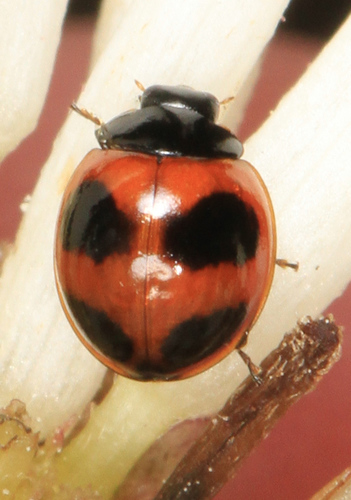
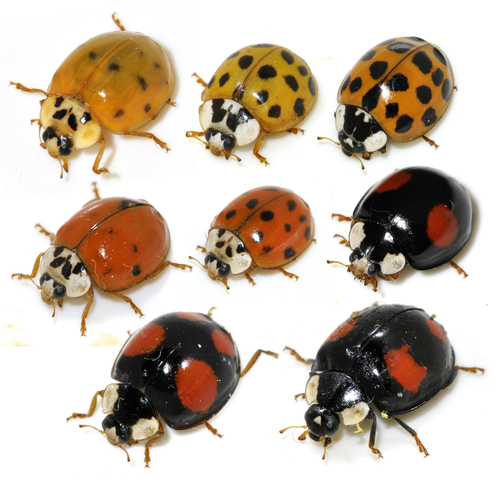
Harmonia axyridis is a coccinellid beetle with a typical domed shape and smooth transition between its elytra (wing coverings), pronotum, and head. Adults measure 5.5 to 8.5 mm in length. The most common color form, f. succinea, is orange or red with 0 to 22 black spots of varying size. Two other common forms, f. conspicua and f. spectabilis, are uniformly black, with two and four red markings respectively. Its pronotum is white with variable black patterning, which can range from a small number of black spots arranged in an M shape to almost entirely black. The underside is dark with a wide reddish-brown border. Many other color forms of this species have been recorded; extreme forms may be entirely black, or show complex mixed patterning of black, orange, and red. This species' color polymorphism is likely hereditary, and may also be affected by the temperature pupae experience, which varies by location and time of year. Darker color variations are more common in Asia than in North America. Eggs of Harmonia axyridis range in yellow shades depending on their age, and turn black one day before hatching. On average, eggs are about 1.2 mm long. The beetle's large size is usually the first clue for identifying this species. Despite its wide color variation, it does not generally share pronotal or elytral patterns with any other species, except unmarked orange or red forms. In Europe, it resembles the much smaller Adalia decempunctata. In America, it resembles the much smaller Mulsantina picta and spotless forms of Adalia bipunctata. When identification is difficult, the underside pattern usually allows for a reliable conclusion. Identification is simplest for common forms, while less common varieties may take longer to identify. Harmonia axyridis always has reddish-brown legs, and the underside of its abdomen is clearly brown even in dark melanic color forms. Harmonia axyridis is native to eastern Asia. Its native range extends west to central Siberia, Kazakhstan, and Uzbekistan, through Russia south to the Himalayas, and east to the Pacific coast, including Japan, Korea, Mongolia, China, and Taiwan. As a voracious predator, it was identified as a biological control agent for aphids and scale insects. As a result, it has been introduced to greenhouses, crop fields, and gardens in many countries, including the United States and parts of Europe. The species is now permanently established in North America (the United States, Canada, Mexico), Central America (Guatemala, Honduras, Costa Rica, Panama), South America (Brazil, Venezuela, Colombia, Ecuador, Peru, Argentina, Chile), Europe (Italy, Spain, the United Kingdom, Denmark, Sweden, Norway, Finland, the Netherlands, Belgium, Luxembourg, France, Germany, the Czech Republic, Slovakia, Hungary, Romania, Serbia, Croatia, Bosnia and Herzegovina, Poland), Israel, New Zealand, and South Africa.