About Harmologa amplexana (Zeller, 1875)
Scientific name: Harmologa amplexana (Zeller, 1875)
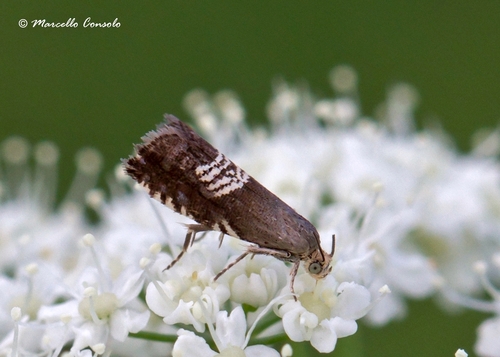
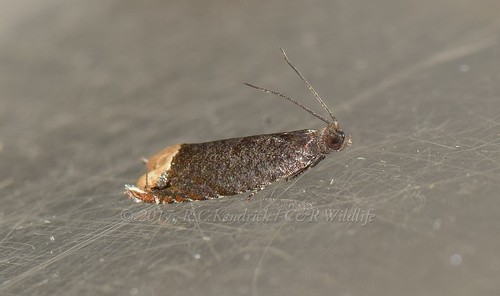
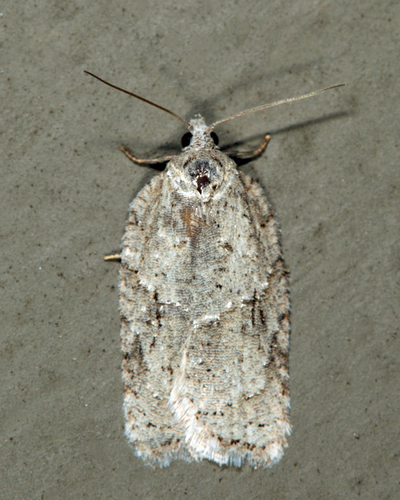
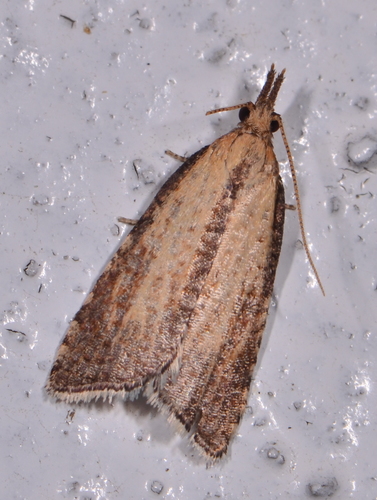
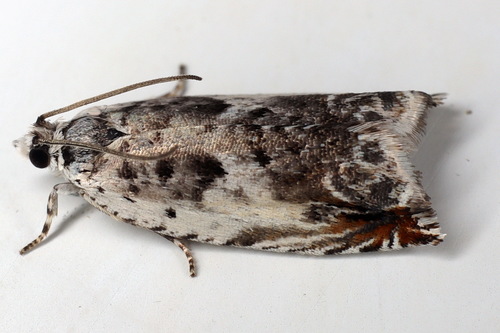
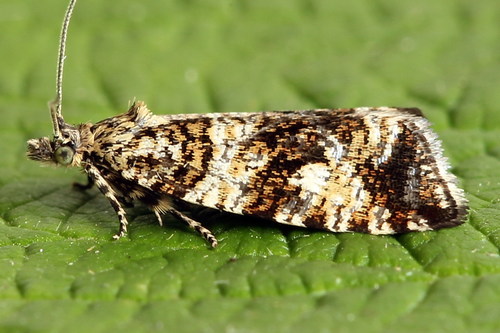
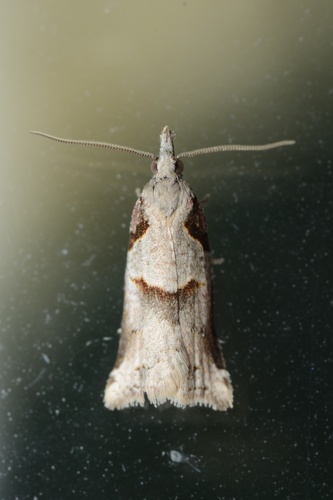
Hudson provided the following description of this species. The wingspan of the male is slightly under 3⁄4 inch, and the wingspan of the female is slightly over 3⁄4 inch. In males, the forewing costa is strongly arched at the base, the apex is pointed, and the termen is curved. In females, the forewing costa is very strongly arched at the base, becoming concave before the very prominent apex, and the termen is very strongly bowed outwards. The forewings are very pale ochreous with brown markings. A narrow, very dark band runs from 1⁄4 of the costa, extending obliquely inwards to the disc, then abruptly to the wing base. This marking is smaller, fainter, and much more curved in females. There is an oblique band that runs from before the middle of the costa to the middle of the dorsum; it is sharply defined towards the base, shaded towards the termen, and obsolete towards the costa in males. An elongate curved mark sits on the costa from the middle almost to the apex; this mark is much larger and touches the central band in males. There are several small markings near the termen, including a brownish patch near the middle, edged towards the termen with two to four blackish dots. In both sexes, the entire forewing is very finely dotted and streaked with minute brown marks. The hindwings are pale yellowish-ochreous with grey mottling. Meyrick noted that this species differs from all other Australian and New Zealand species by its produced forewing apex, excavated forewing hindmargin, and angulated dark streak beneath the basal portion of the costa.
H. amplexana is endemic to New Zealand. It is found from the centre of the North Island south to and including the Otago region of the South Island. This species inhabits both native forests and cultivated gardens. Its known larval host plants are Muehlenbeckia complexa and Olearia odorata.