About Harmochirus insulanus (Kishida, 1914)
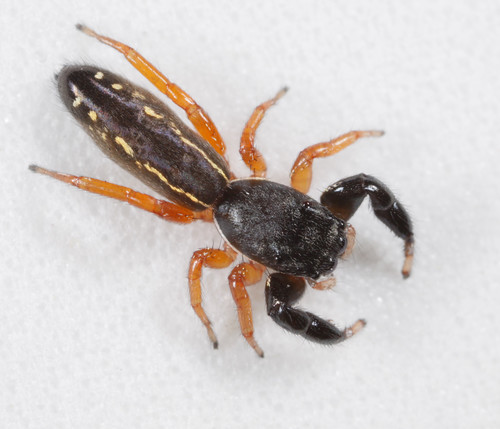
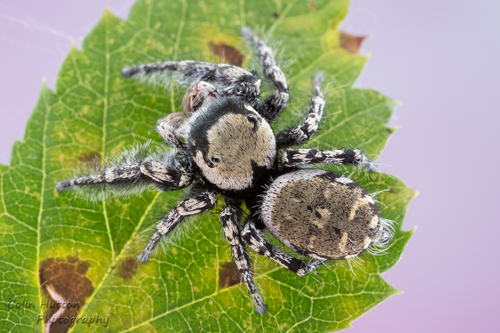
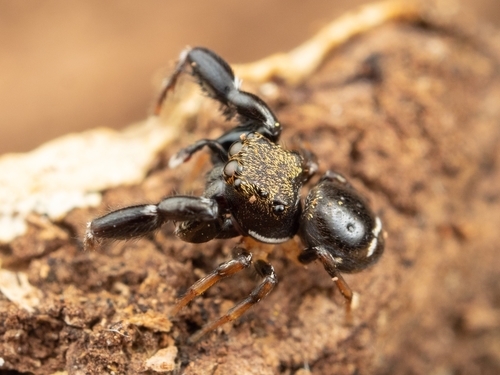
This species has the scientific name Harmochirus insulanus (Kishida, 1914). For male individuals, the prosoma is black, covered with white scales on its dorsal, frontal, and lateral surfaces. The clypeus is black, with the eyes surrounded by brown hairs. The opisthosoma is blackish brown, with a posterior transverse band made up of white scales. The first pair of legs is black except for the brown metatarsus and tarsus, and this leg pair has distinctive rows of black, scale-like setae on specific surfaces. The remaining legs have black femora, while their patellae, tibiae, metatarsi, and tarsi are yellowish brown. Female individuals of this species are generally paler in overall coloration. The male palp has a short, non-coiled embolus and a spherical tegulum, which has a membranous peak on its retrolateral surface. The female epigyne has a central structure with copulatory openings located anteriorly, along with short, simple insemination ducts. H. insulanus is closely related to H. brachiatus, but the two species can be distinguished by the shape and position of the membranous tegular "peak" in males, and the structure of the spermathecae in females. H. insulanus is distributed across East Asia, with recorded occurrences in China, Korea, Japan, and Vietnam. Within Japan, the species occurs on the islands of Honshu, Shikoku, and Kyushu.