About Hardenbergia violacea (Schneev.) Stearn
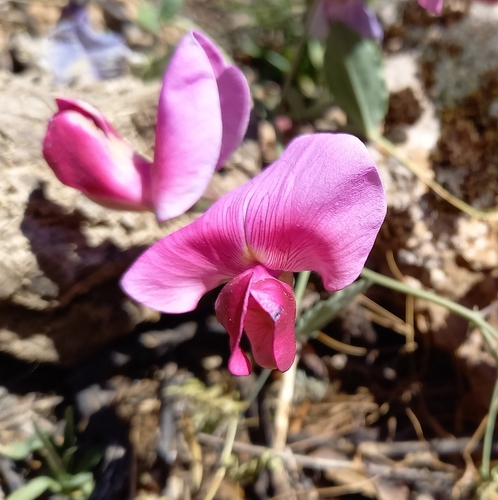
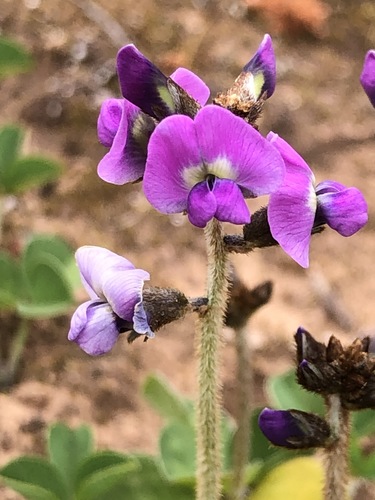
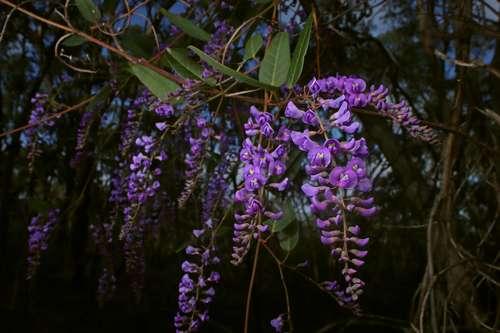
Hardenbergia violacea (Schneev.) Stearn is a prostrate or climbing sub-shrub with wiry stems that reach 2 m (6 ft 7 in) or more in length. Its leaves range from egg-shaped to lance-shaped, measuring 30–100 mm (1.2–3.9 in) long and 10–50 mm (0.39–1.97 in) wide, and grow on a petiole around 10 mm (0.39 in) long. The leaves are leathery, hairless, and paler on their lower surface. Flowers are arranged in racemes holding 20 to 40 individual blooms, each borne on a pedicel that is mostly 2–4 mm (0.079–0.157 in) long. Sepals are 3–4 mm (0.12–0.16 in) long, joined at the base to form a bell-shaped tube with triangular teeth. Petals are around 8 mm (0.31 in) long, and most are purple; the standard petal has a yellowish spot and a notch at its tip, the wing petals are egg-shaped with the narrower end oriented toward the base, and the keel petal is curved. Flowering occurs mainly from August to November. The fruit is a pod 20–45 mm (0.79–1.77 in) long that holds 6 to 8 kidney-shaped seeds. Flowers are typically purple or violet, but pink, white, and other colors sometimes appear. H. violacea regrows from its root system after fire. Early European settlers experimented with using the species' roots as a substitute for sarsaparilla.
Hardenbergia violacea grows in a wide range of habitats, but is most common in open forests, woodlands, and undisturbed areas, ranging from sea level to around 1,000 m (3,300 ft) above sea level. It is found in eastern Queensland, eastern New South Wales, south-eastern Victoria, and southern South Australia. There is only one known population in Tasmania, where the species is listed as endangered under the Tasmanian Government Threatened Species Protection Act 1995.
In horticulture, Hardenbergia violacea is widely grown as a garden plant, and many cultivars are currently available. It is hardy in mild and coastal regions of the United Kingdom where temperatures do not drop below −5 °C (23 °F), but requires a sheltered site that faces south or west. It can alternatively be grown indoors in full daylight, for example in an unheated conservatory or greenhouse. It has been awarded the Royal Horticultural Society's Award of Garden Merit. The seeds of H. violacea stay viable for many years, and propagation is done using seeds treated by adding boiling water or abrading the seed coat. Plants grow best in full sun in well-drained soil, are moderately tolerant of frost, and respond well to pruning.