About Hardenbergia comptoniana (Andrews) Benth.
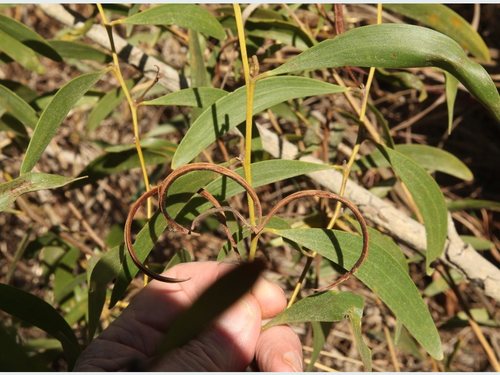
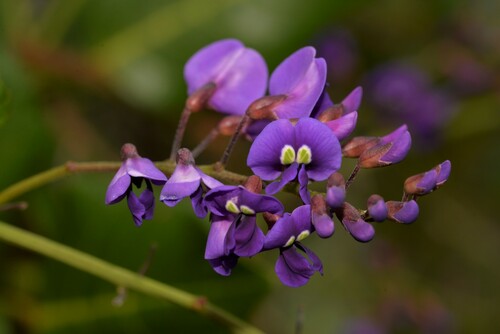
Hardenbergia comptoniana (Andrews) Benth. is a vigorous twining vine, easily distinguished from its closest relative Hardenbergia violacea by its characteristic narrow trifoliate leaves; H. violacea has entire leaves instead. Its pea-shaped flowers bloom from August to November, which corresponds to late winter to spring in the Southern Hemisphere. Flower colors range from mauve to purple to dark blue, and pink and white forms have also been recorded. The two eye spots on the flower's standard are white, which differs from the light green-yellow spots found on H. violacea. The flowers are arranged in drooping racemes. After flowering, smooth grey-brown cylindrical seed pods develop. These seed pods are around 3.5 centimetres (1.4 inches) long, and make an audible 'pop' when they release their seeds. In terms of distribution and habitat, Hardenbergia comptoniana occurs on the coastal plain from Geraldton to Albany in Western Australia, where it grows on sand dunes, limestone areas, and sandplains. It also grows in forested areas further inland, on both sand-based and clay-based soils. For use in horticulture, H. comptoniana was introduced to cultivation in England in 1810 by the 1st Marchioness of Northampton. This plant is fairly vigorous, and can cover a 3 by 3 metres (9.8 by 9.8 ft) area within two years, and will smother smaller plants if allowed to grow over them. Partly shaded positions are the most suitable for it in garden settings. Once established, it can grow high into surrounding trees, or rapidly cover fences or trellises. Propagation from seed is straightforward, and cuttings can also be rooted successfully.