About Hapalopilus rutilans (Pers.) Murrill
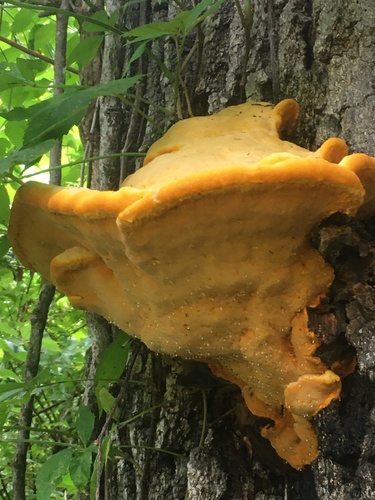
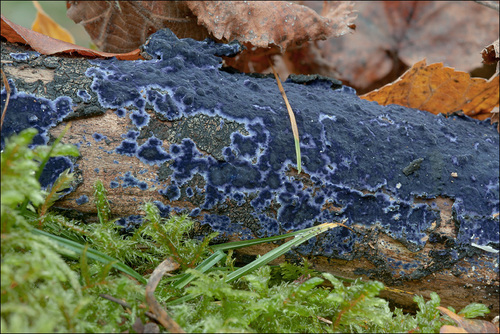
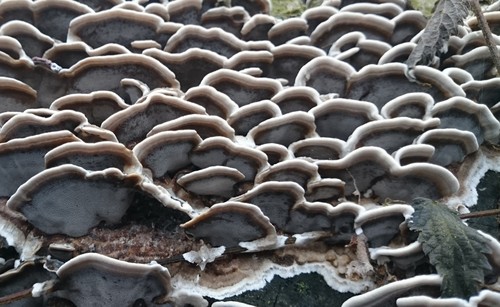
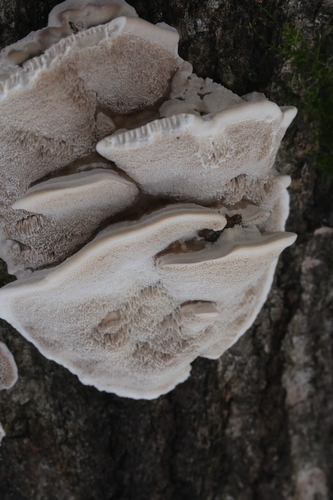
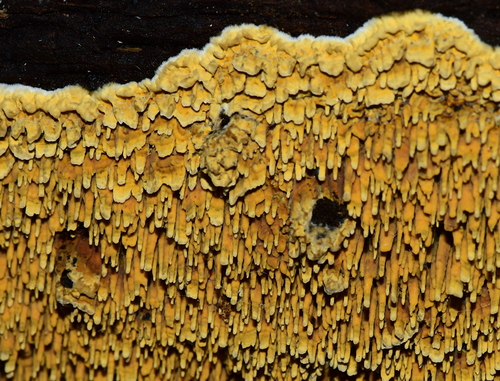
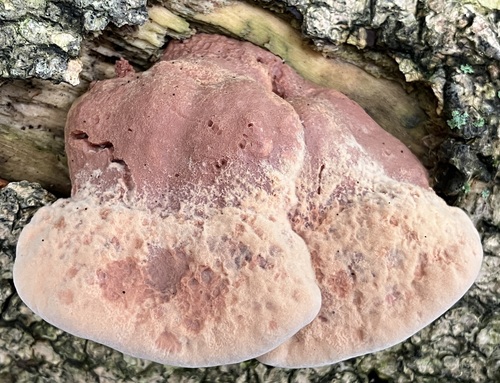
Hapalopilus rutilans (Pers.) Murrill has fan-shaped to semicircular, convex caps that reach 2.5–12 cm (1.0–4.7 in) in diameter. It has no stalk, and instead attaches broadly to its growing substrate. Young fruit bodies start out soft and spongy, but become hard and brittle after they lose moisture. The cap surface is covered in matted hairs, marked with shallow concentric furrows, and colored a dull brownish-orange. Flesh is up to 3 cm (1.2 in) thick at its thickest point, and is pale cinnamon in color. The pore surface ranges from yellowish to brownish, with angular pores that number roughly 2–4 per millimeter. In young fruit bodies, bruising the pore surface causes it to turn reddish brown. The mushroom's odor and taste are either sweetish or indistinct. This fungus produces a white spore print. Its spores are elliptical to cylindrical, smooth, and hyaline (translucent), and measure 3.5–5 by 2–3 μm. Spore-bearing cells called basidia are club-shaped, four-spored, and measure 18–22 by 5–5.6 μm. H. rutilans has a monomitic hyphal system that only contains generative hyphae with clamp connections. In the flesh, these hyphae are thick-walled, highly branched, and reach up to 10 μm in diameter; hyphae that make up the pores and subhymenium are thinner, reaching up to 6 μm wide, and less branched. A chemical test can help identify H. rutilans: all parts of the fruit body will instantly stain bright violet when a drop of alkaline solution is applied. Dilute 3–10% potassium hydroxide (KOH) is most often used for this identification test. Hapalopilus rutilans is a saprobic species that causes white rot in its host. Its fruit bodies grow singly, in groups, or in fused overlapping clusters on the wood of dead, decaying deciduous trees. Preferred host trees include Quercus (oak), Fagus (beech), and Betula (birch), though it has been recorded growing on conifer wood on rare occasions. In central Europe, its preferred host is oak, while in northern Europe it is most commonly found growing on Corylus and Sorbus. Fruiting typically occurs from early summer through autumn, but the tough fruit bodies are persistent and can be found outside of this typical growing season. Hapalopilus rutilans has a mostly circumboreal distribution in the north temperate zone, and has been found in North Africa, Asia, Europe, and North America. It has also been recorded outside this region in Australia and Oceania. In North America, it can be found as far north as Canada's Northwest Territories, and is more common in the eastern and southwestern parts of the continent. In Europe, its northern range extends to Porsanger, Norway. It was first reported in India in 2011, found in forest depots of Chhattisgarh growing on stored logs of several native trees: Anogeissus latifolia, Chloroxylon swietenia, Desmodium oojeinense, Shorea robusta, and Terminalia elliptica. Species of fungus beetle that are known to inhabit H. rutilans fruit bodies and rear their young there include Sulcacis affinis, Hallomenus axillaris, H. binotatus, and Orchesia fasciata. Contrary to the common myth that no polypores are dangerous, the fruit bodies of H. rutilans are neurotoxic if eaten. The toxin responsible is polyporic acid, a terphenyl compound first isolated from a mycelial culture of this fungus in 1877. This chemical makes up 20–40% of the dry weight of the fruit bodies, and works by inhibiting the enzyme dihydroorotate dehydrogenase. Polyporic acid occurs in other mushrooms, but in much lower concentrations. A 1992 poisoning case involved a German family that ate H. rutilans; all three developed nausea, impaired movement, visual impairment, and liver and kidney failure, with symptoms starting roughly 12 hours after consumption. All three victims also had temporary violet discoloration of their urine, and made a full recovery after one week. Similar symptoms and full recovery were reported in a 2013 poisoning case, where the fungus was misidentified as the edible Fistulina hepatica. The pattern of symptoms caused by consuming H. rutilans is called neurotoxic delayed syndrome. Hapalopilus rutilans is very popular with people who produce mushroom dyes. When used with alkaline fixatives, its fruit bodies can produce striking violet colors.