About Hammarbya paludosa (L.) Kuntze
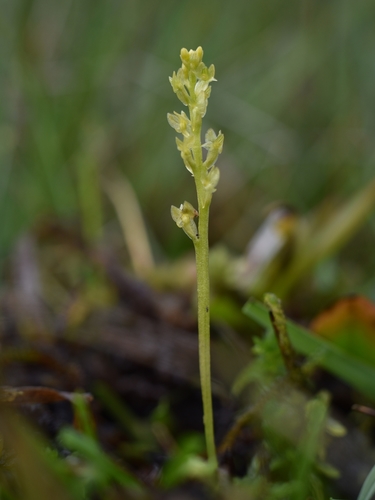
Hammarbya paludosa (L.) Kuntze is a small, inconspicuous orchid species that can reach 15 cm in height, though most individuals grow between 4 and 8 cm tall. Its yellow-green stem has three to five corners, and grows from a small pseudobulb wrapped in 2 to 5 reduced leaves. It produces 2, 3, or occasionally 4 basal leaves, which are oval to oblong, fleshy, and pale green or yellow-green, with edges and tips that curve inwards. One to three small, scale-like leaves grow higher up the stem. Small bulblet-like reproductive structures may form on the margins of the leaves. Flowers are arranged in a spike-like raceme 1.5–6 cm long that holds up to 25 flowers. The flowers are small and greenish, measuring about 2 mm wide and 4 mm tall. They have three sepals and three petals, one of which is modified to form a lip. One dorsal sepal points downwards, while two lateral sepals point upwards. The two unmodified petals are small, narrow, and strap-shaped, and curve back around the sepals. The short, triangular lip is dark green with paler stripes, and points upwards and forwards. The flowers carry a sweet, cucumber-like scent. Unlike most orchids, which produce resupinate flowers that twist 180° during development so the lip points downwards, H. paludosa flowers twist an additional 180°, leaving the lip pointing upwards. This feature was noted by Charles Darwin in his 1862 book Fertilisation of Orchids. This orchid has a wide distribution across the Northern Hemisphere. In Europe, it occurs north to 69° in Scandinavia, and south to the Italian Alps, Balkans, and Romania. It is found locally across southern Siberia, extending east to Sakhalin and Japan. In North America, it ranges from Alaska east to Ontario and south to Minnesota. In the British Isles, it is widespread but very local, with the largest populations in north-west Scotland. It has been extirpated from much of England, but remains more frequent in the New Forest. It grows in bogs near streams and ditches, or in areas with slow moving surface water. It prefers acidic conditions, but will sometimes grow in more alkaline habitats. It most commonly grows in areas with dense cover of Sphagnum moss, but can also grow on bare ground or among sedges and grasses. In the British Isles, it flowers between June and September. Flowers of H. paludosa are pollinated by small flies. The species reproduces via seeds, or by bulbils: small buds that detach from the parent plant and develop into new individuals. This orchid has no true roots, and depends on symbiotic fungi in its rhizome to obtain nutrients. Bulbils do not carry fungal symbionts from the parent plant, and must become infected by the correct soil fungus species to develop into mature plants. Its rhizome grows vertically in the soil, and a new pseudobulb develops at the top each year.