About Hamirostra melanosternon (Gould, 1841)
The scientific name of black-breasted buzzard is Hamirostra melanosternon (Gould, 1841).
Description: In body size, the black-breasted buzzard is intermediate between the larger, well-known wedge-tailed eagle (Aquila audax) and the smaller little eagle (Hieraaetus morphnoides). It is one of Australia's largest birds of prey, and one of the world's largest kites, alongside the red kite — the red kite is slightly less heavy but has a longer total length. An adult black-breasted buzzard has a height (including its short square tail) of 51 to 61 cm (20 to 24 in). Its outstretched wingspan is 141 to 156 cm (4 ft 8 in to 5 ft 1 in). In flight, the bird is distinctive because its wings are conspicuously long relative to its stout body and tail. This species is sexually monomorphic (meaning males and females have identical physical appearance), though the adult female is slightly larger. An adult female weighs approximately 1,330 g (2.93 lb), while an adult male weighs approximately 1,196 g (2.637 lb). The overall weight range for the species is 1,150 to 1,600 g (2.54 to 3.53 lb). It is most closely related to the Square-tailed kite (Lophoictinia isura).
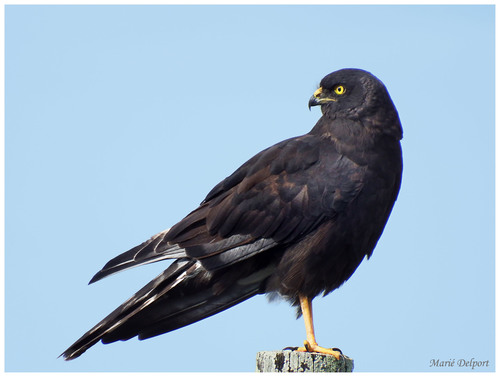
Adult black-breasted buzzards have distinctive markings in their plumage, making them striking in appearance. From the underside, the body and wings are mainly black, contrasted by thick white panels near the wingtips. From above, the black plumage is broken up by rich mottled red across the back and shoulders. Immature and juvenile black-breasted buzzards have pale brown colouring, and their dark to black streaks become more prominent as they age. Chicks are covered in white down, which is described as 'hair-like' on their heads. Adult black-breasted buzzards can be individually identified in flight by broken or missing flight feathers, and when perched closely together, they can be told apart by subtle differences in the red colouring of their back and shoulders.
The common call of the black-breasted buzzard is described as a repeated hoarse yelping, or a short sharp yap or yelp. Adult females also produce a soft drawn-out wheezing call to solicit their mate to copulate, build the nest, forage for food, and defend the nest. Young buzzards also use a wheezing call to beg food from their parents.
Distribution and habitat: The black-breasted buzzard has a wide but sparse distribution across northern and inland Australia, in areas with annual rainfall under 500 mm. Its range covers northeastern South Australia, northwestern New South Wales, northern Queensland, the Northern Territory, and the northwestern outer area of Western Australia. It does not occur in Victoria, the Australian Capital Territory, or Tasmania, due to these regions' wetter temperate climates. It can be found in wooded and open habitats, and is most commonly observed in riparian forests and tall-open woodlands surrounded by mid-dense shrublands. In a study of raptor habitat association in central Australia, the black-breasted buzzard was most commonly observed in open woodland of River Red Gum (Eucalyptus camaldulensis), showing a significant preference for this habitat type.
Reproduction: The black-breasted buzzard is usually monogamous and forms lifelong pair-bonds. It nests in trees that are notably tall and large in girth, which are generally larger and more standalone than other available trees. These nesting trees can be dead with bare exposed limbs, or alive with foliage. Nests are positioned in prominent forks high up in the tree canopies. Both parents contribute equally to nest-building, and often work together on the nest structure. Nests are built from dead sticks and leafy branches. Nest materials are gathered from the ground or broken off from trees, and carried to the nest site in the bird's feet or beak. Measured nest dimensions are 1.2m long × 0.8m wide × 0.4m deep. The nests of the black-breasted buzzard are larger than the nests of any other raptor species, including the larger-bodied wedge-tailed eagle.
The black-breasted buzzard lays eggs from August to October. Breeding is thought to be stimulated by longer day length, as well as increased food availability that is often linked to rainfall events. A typical clutch has two eggs, which are laid about 8–13 days apart, and incubated for 32–38 days. Nestlings stay in the nest for 68–73 days before fledging around December. The female tends the nest most of the time, while the male hunts and brings back food. Usually only one chick per nest survives to fledge each breeding season. Fresh leafy branches, separate from the basic nest structure, are added periodically during the breeding cycle. This added greenery is thought to serve medicinal purposes, such as helping control parasites and pathogens, and/or reducing bacteria. Other hypotheses suggest the greenery may play a role in courtship, and/or assist in nestling development. Though this greenery-adding behaviour occurs in a variety of bird species across different climates and habitats worldwide, it is not yet fully understood.