About Hamadryas iphthime (Bates, 1864)
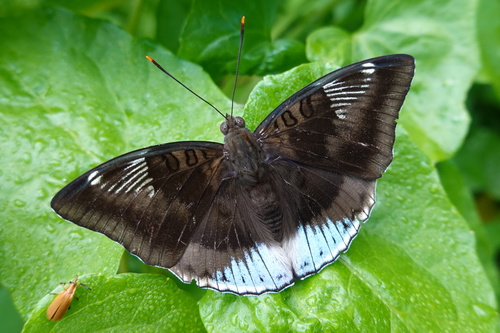
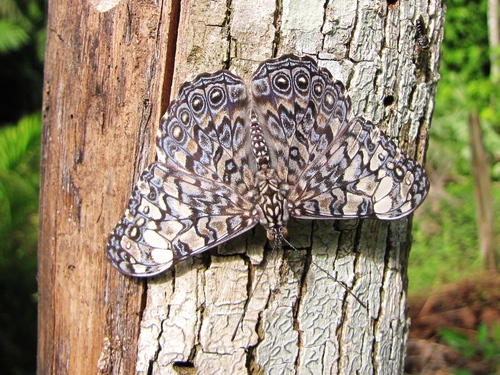
Commonly known as the ringless blue cracker, this butterfly species has a scientific name Hamadryas iphthime (Bates, 1864). The wingspan of adult ringless blue crackers is approximately 7.5 cm (3 in). The upper surface of the wings is mottled grey, brown, and white. There is no red bar on the forewing, and the hindwing has submarginal black spots surrounded by blue, brown, and blue rings, with a central white crescent or oval marking. The undersurface of the wings is whitish, with black rings near the hind margin that resemble those found on Hamadryas feronia. Larvae are black with fine, potentially indistinct longitudinal yellow lines, pale spines, and two horns on the head. Pupae are bright green with some white bands, a silvery rim on their yellowish-green wings, and a V-shaped pair of elongated green "rabbit ears" with a white seam on the head. The ringless blue cracker’s range extends from Mexico, through Costa Rica and Panama, to Guyana, Colombia, Peru, Bolivia, and southern Brazil; a single vagrant individual has been reported in Texas, USA. This species inhabits glades and edges of tropical forests. Larvae feed on vines of the family Euphorbiaceae; recorded host plants include Dalechampia triphylla, Dalechampia ficifolia, and Dalechampia stipulacea in Brazil, and Dalechampia cissifolia in Panama. Females lay eggs on the underside of host plant leaves. Larvae feed on host leaves and are not gregarious. They rest in an unusual posture where only their prolegs touch the leaf blade, and their horned head projects forward. Adult ringless blue crackers feed on rotting fruit and do not visit flowers. They commonly perch head-down on tree trunks, with their wings spread flat against the bark. When another butterfly approaches, a male will dart away from the trunk and produce a cracking sound. This behavior is thought to help males identify the sex of approaching individuals: males respond with clicking, while females remain silent. At night, adult butterflies roost separately among foliage. In tropical regions, adults can be seen flying throughout most of the year. In Mexico, they are most frequently observed during July and August.