About Hamadryas glauconome (Bates, 1864)
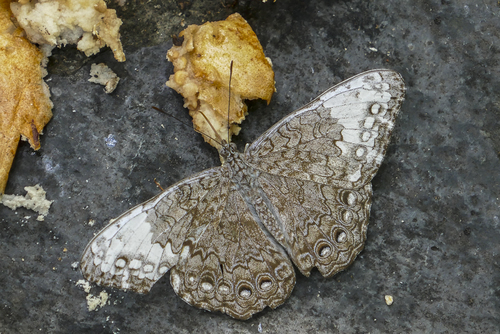
Adults of Hamadryas glauconome, commonly called the pale cracker, have wings mottled in grey, brown, and white. They are very similar in appearance to the related grey cracker (Hamadryas februa). Like the grey cracker, pale crackers have small submarginal eyespots that include orange scales on the underside of their hindwings, and these two species are the only members of the genus Hamadryas that have orange scales in their eyespots. The pale cracker can be distinguished from the grey cracker by its lack of a small red bar on the forewing. The pale cracker is native to Mexico, Central America, and South America, ranging as far south as Guatemala and Peru. It has been recorded as a vagrant stray in the United States: it is a rare stray in southeastern Arizona, has one recorded sighting in south Texas, and has also been recorded in Florida. This butterfly inhabits open areas with scattered trees, occurring in both moist and semi-arid environments. Adult pale crackers do not visit flowers, instead feeding on rotting fruit, carrion, and mud. Adults habitually rest on tree trunks, where their mottled wing pattern camouflages them and makes them difficult to spot. When another butterfly approaches, a male pale cracker will take flight and emit a distinct cracking sound. If the approaching butterfly is also a male, it will respond with its own crack, while a female will remain silent. This acoustic signal allows the male to identify and select a mate of the opposite sex. In the evening, pale crackers gather together on a single tree trunk before flying off to nearby trees and bushes to roost individually. Females lay their eggs on the leaves of vines in the family Euphorbiaceae; the confirmed host plant recorded for Guatemala is Dalechampia scandens.