About Hamadryas feronia (Linnaeus, 1758)
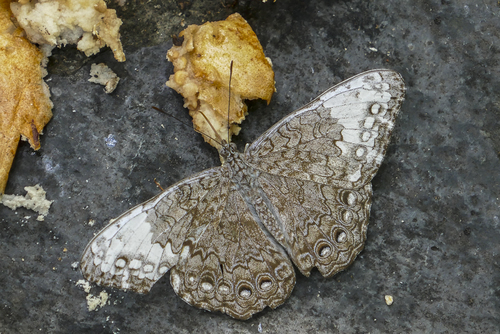
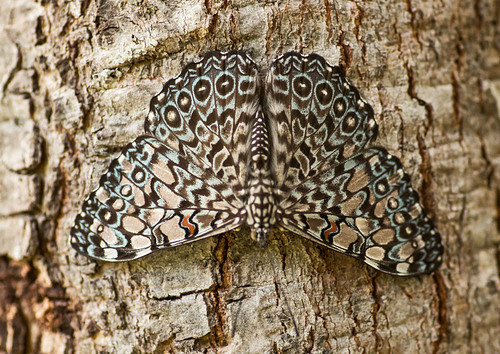
Hamadryas feronia is similar in appearance to Hamadryas guatemalena and Hamadryas iphthime. The upperside of its fore wing has a mosaic pattern of white, brown and bluish-grey, with a row of small eyespots running parallel to the outer margin; a small red bar sits in the discal cell. The upperside of the hind wing has a similar pattern, but it has fewer white patches and larger, more distinct eyespots. The underside of the fore wing is white or whitish-tan with dark markings, a small red bar and a black submarginal eyespot. The underside of the hind wing is also white or whitish-tan with dark markings, and has blue rings containing larger eyespots near the rear margin. The larva of Hamadryas feronia has two colour morphs. One morph is bluish-black on the upper side, with brownish-white speckles and reddish spots on the side. The other is greyish-green, with a pale longitudinal line on the side. The larva has dorsal spines on the second and third thoracic segments, and on the seventh and eighth abdominal segments. The pupa has two long processes on its anterior end. Two subspecies of Hamadryas feronia are currently recognised. The nominate subspecies H. feronia feronia is found in Brazil, Paraguay and Peru. The subspecies H. feronia farinulenta occurs in Mexico, Honduras, Venezuela, Colombia and Trinidad. This butterfly inhabits open areas that contain trees. In Mexico, adult Hamadryas feronia are active on the wing throughout the year, and are most common between June and September. The larvae feed on vines belonging to the family Euphorbiaceae; in South America, Dalechampia triphylla is often the host plant. Adult butterflies feed on rotting fruit. They frequently perch head-down, flattened against the surface of tree trunks, and their colouring provides effective camouflage against tree bark. When another butterfly approaches, a male will fly out and produce a characteristic cracking sound, which it likely makes using a pair of rods on its abdomen. If the approaching individual is another male, it will click in response; if the approaching individual is a female, it will remain silent. Females also perch on tree trunks. In an experiment that offered perching spots in black, grey and white, males showed a preference for white perches, while females preferred grey perches.