About Halyzia sedecimguttata (Linnaeus, 1758)
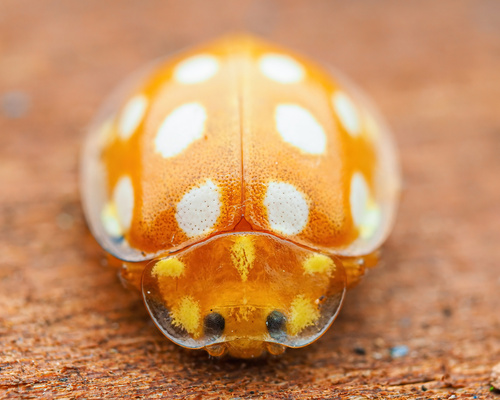
Halyzia sedecimguttata reaches a body length of 5–6 millimetres (0.20–0.24 inches). Individuals of this beetle species have oval bodies that are rounder rather than elongated. They have black compound eyes, and long, light-brown antennae that are slightly thickened at the tip. Their most notable appearance features are a bright orange base color, and 16 (sometimes fewer) large creamy white spots on the elytra, with eight spots on each elytron. The neck shield, which typically covers the head, bears orange spots. A characteristic trait of this species is the slightly transparent edges of the elytra; transparent areas are also present on both sides of the neck shield. Halyzia sedecimguttata is quite similar in appearance to Calvia decemguttata and Vibidia duodecimguttata. This species is widespread across Europe, European Russia, the Caucasus, Siberia, the Russian Far East, Belarus, Ukraine, Transcaucasia, Kazakhstan, Asia Minor, Mongolia, Northern China, and Japan. It was previously uncommon in Ireland and Britain, but became established there during the 20th century and is now common across many parts of both regions. It is commonly found in woodlands, and occurs more often in dry areas. It mainly inhabits deciduous woodlands (including Western European broadleaf forests and Palearctic temperate broadleaf and mixed forest), as well as parkland, forest edges, and hedgerows.