About Halysidota harrisii Walsh, 1864
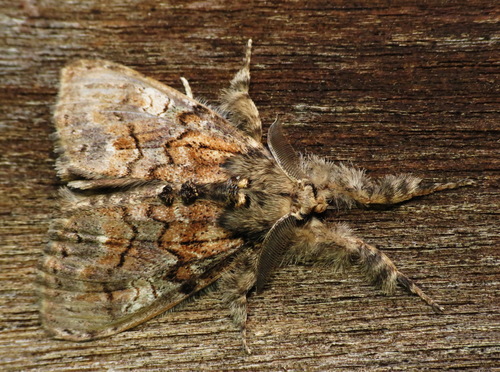
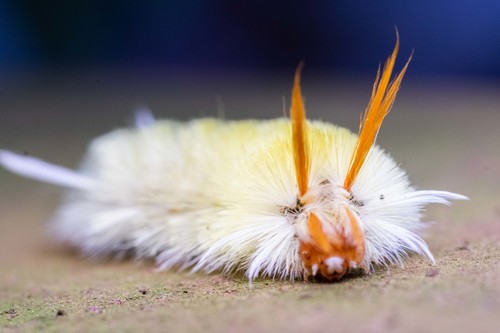
Halysidota harrisii, commonly called the sycamore tiger moth, has distinct physical traits for both its larval and adult life stages. The larvae have yellow-orange heads and hair-covered bodies, and reach an approximate length of 25 to 35 mm. Toward the front of their bodies, larvae have two pairs of long orange hair-pencils and two pairs of white hair-pencils; they also have one additional pair of white hair-pencils near the back of their bodies. Adult moths are pale yellow with dark bands across their forewings. Each forewing measures 24 to 26 mm long, giving the species an approximate total wingspan of 50 mm. Adult Halysidota harrisii are nearly indistinguishable from the closely related species Halysidota tesselaris.
This moth species completes two full generations per year. Adult moths emerge from overwintering cocoons between May and June. After mating, females lay egg masses on tree bark and the undersides of leaves. The larvae feed exclusively on the American sycamore tree, Platanus occidentalis. First-generation larvae pupate in late June and July, emerging as the second generation of adult moths in July and August. The offspring of this second generation spin cocoons in late September and October, and overwinter as pupae to begin the cycle again the following year.