About Halocynthia igaboja Oka, 1906
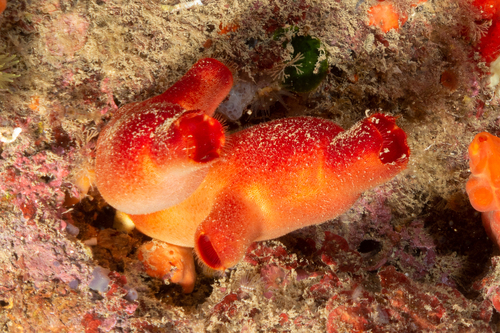
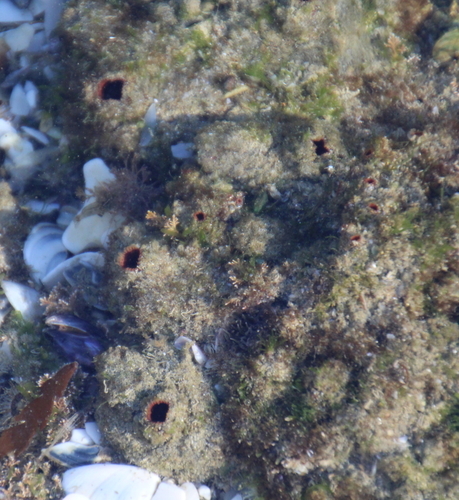
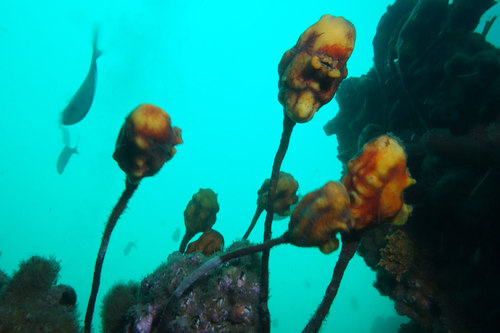
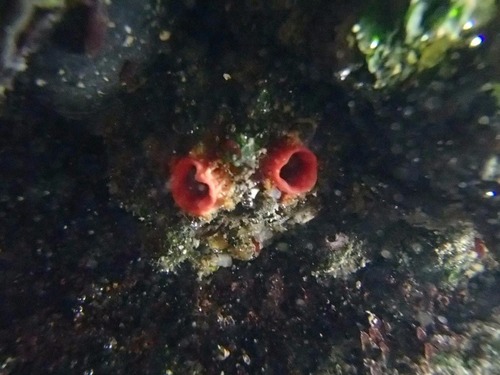
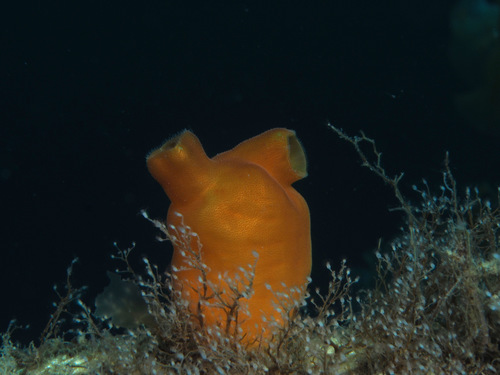
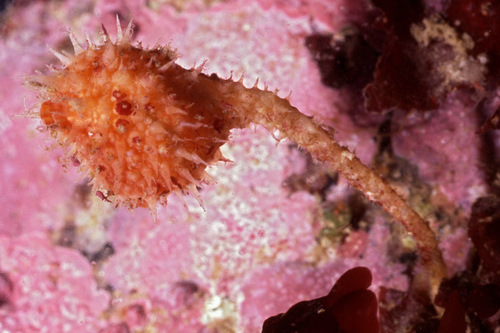
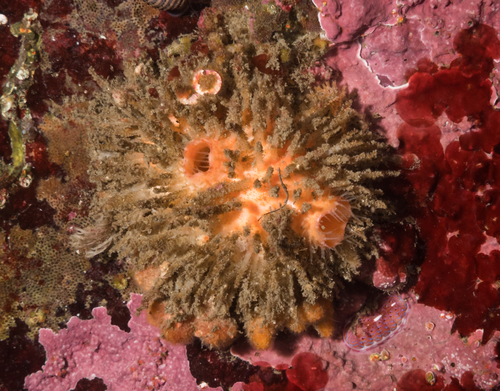
Halocynthia igaboja Oka, 1906, commonly called the sea hedgehog, is a species of solitary tunicate. It has a roughly globular body with a leathery outer body wall called a tunic, and two distinct siphons. The buccal siphon draws water into the body, while the atrial siphon expels water back out. The tunic of this species is dark brown, but it is almost entirely hidden by the many large, branching, spine-like processes that cover the entire body. The longest spines have rings of curved secondary spines that point backward. The siphons are often reddish or orangish; the buccal siphon is located at the top of the animal and is surrounded by 12 to 50 tentacles, while the atrial siphon sits between one-third and one-half of the way down the body. With a maximum height of 10 cm (4 in) and a width between 2 and 5 cm (0.8 to 2.0 in), this is one of the largest solitary tunicate species found in the Pacific Northwest. It may be confused with the cactus sea squirt (Boltenia echinata), but H. igaboja is distinctly spinier and larger than that species. The sea hedgehog is distributed across Japan, southeastern Asia, and the Pacific Coast of North America, ranging from Alaska to California. It prefers rocky or gravelly habitats with strong currents, and can be found at depths from the intertidal zone down to around 165 m (540 ft). The sea hedgehog is a suspension feeder: it draws water through its body and filters out plankton and organic material to eat. When currents are weak, detritus and diatoms build up on its spiny processes, making the animal nearly invisible. Its spines work as a defense against the Oregon hairy triton, a predatory gastropod mollusc. The bristly sea squirt Boltenia villosa shares the same habitat but is less spiny; it defends itself by acting as an epibiont and preferentially settling on the spines of the sea hedgehog. This species is semi-gregarious, and is also cannibalistic, eating its own eggs and larvae.