About Halocarpus bidwillii (Hook.f. ex Kirk) Quinn
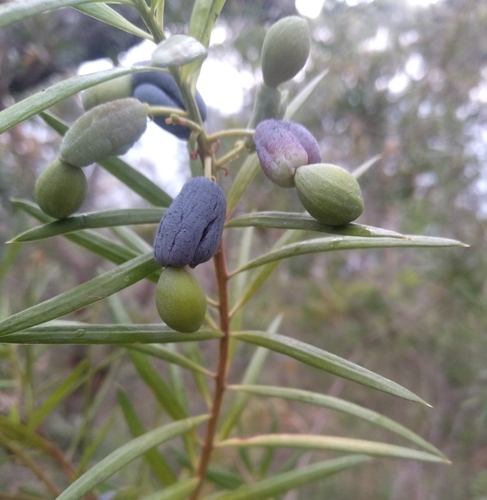
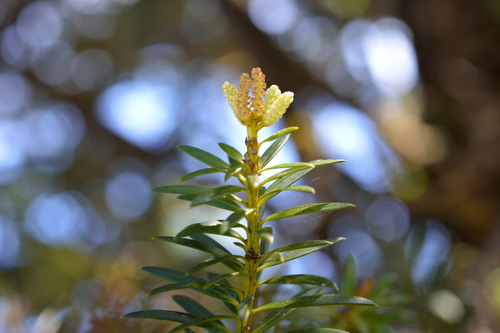
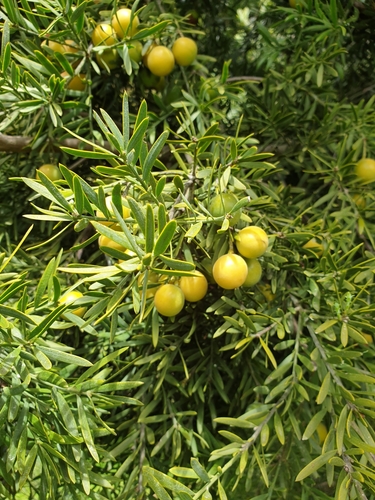
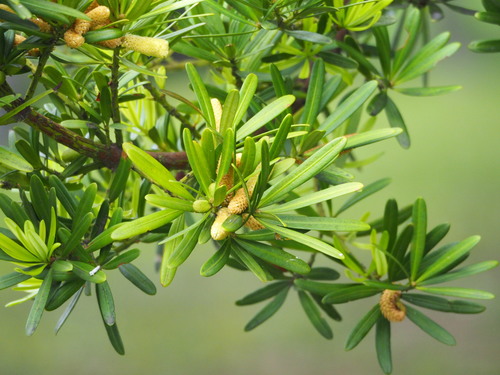
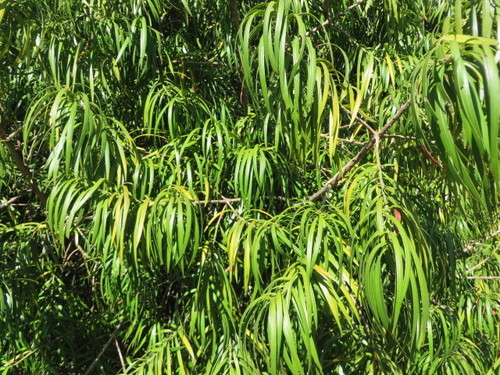
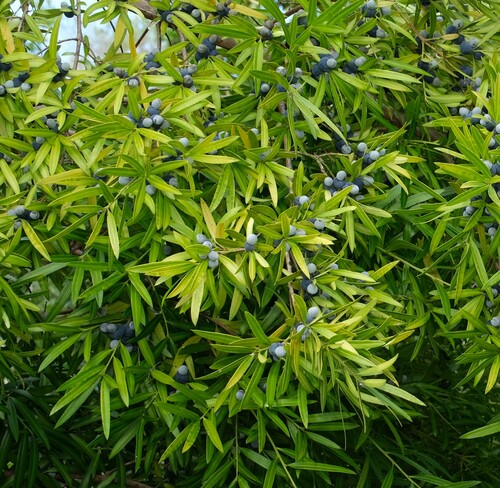
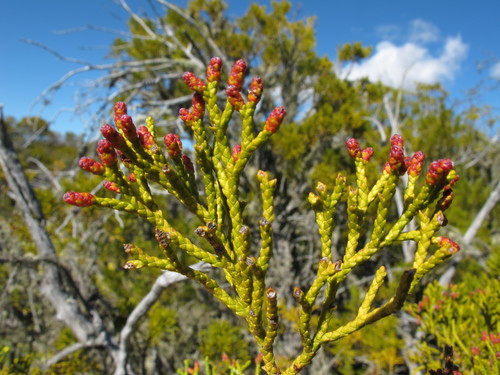
Halocarpus bidwillii, commonly called mountain pine or bog pine, grows as a shrub or small tree, reaching up to 4.8 m (15.7 ft) in height. It has a short trunk that was noted by Kirk to "rarely exceed" 1 foot in diameter, and more commonly measures 30–40 cm (12–16 in) thick at breast height. Its bark ranges from red to brown, and trunks usually grow multiple branches, though occasionally only a single branch forms. In rare cases, roots of its spreading horizontal branches form new shrubs around the parent plant, creating an extensive low growth that resembles a large low shrub or tree; the original parent may die, leaving the thin, red outlying shrubs intact. Leaf appearance changes drastically with the plant's age. In the juvenile stage, leaves are linear, flat, and spreading, similar to pine needles. Mature plants have leathery, 1–2 mm long leaves that overlap in a scaled pattern like fish scales. Fresh leaves are green, but turn brown to red when dried. Flowering occurs between October and December; small male cones, 3–5 mm long, grow brown to red at the tips of the mature scale-like leaves. Stomata are visible to the naked eye as white spots. Pollen cones are solitary and terminal, around 3–5 mm long. Female structures have an appendage adnate to the base of the carpel, with an inverted, drooping ovule. The seed of this species forms inside a fleshy, waxy white cup, and ranges in colour from dark brown to black-brown to purple-brown. The 2–3 mm long seed is subglobose and compressed, with a V-shaped white to yellow aril under the seed. Including the aril, the whole seed structure is hairless, smooth, shiny, oval-oblong, compressed, 3–4.5 mm long, and dark brown to dark purple-brown. Bog pines are easy to identify when fruiting by the waxy white (slightly yellowish) aril beneath the seed. Vegetatively, compared to other Halocarpus species, mountain pine grows as a small multi-branched shrub to small tree, has weak keel-shaped leaves, and more slender, initially quadrangular branchlets. Mountain pine seeds are easily confused with those of the closely related H. biformis; they can be distinguished by significant longitudinal grooves on the ventral and dorsal surfaces of H. bidwillii seeds (sometimes only on the ventral surface). Halocarpus bidwillii is endemic to New Zealand, distributed from Coromandel to the far south; it occurs at lower altitudes as latitude increases. In the North Island, it is found in Taupō county near Rotoaira, the central volcanic plateau, and the Kaingaroa plains, growing only in montane to alpine habitats, typically between 600 and 1500 m elevation. In the South Island, mountain pine is common in the mountainous regions of Nelson, Canterbury, and Otago, growing as high as 4,500 ft (1,400 m) above sea level in the Canterbury Alps. It also grows at sea level on Stewart Island. It occupies a wide range of habitats, and is most common in montane to subalpine habitats south of 39º latitude. Across its range, the average annual temperature is 8.5°C, the average minimum temperature in the coldest month is −0.8°C, and the average annual precipitation is 2,458 mm (2.458 m). While it is primarily found in montane to alpine elevations in the North Island, it can also grow well in lowland conditions, as seen in its sea-level occurrence on Stewart Island. Mountain pine is a hardy species that tolerates a wide range of ground conditions, growing equally well in bog environments and dry stony ground, and growing extremely effectively in stony ground near Te Anau, as well as on wetland margins, frost flats, and riverbeds. It is one of the three most frost-resistant New Zealand conifers, and can typically tolerate frosts below −7 °C. It often grows in poor soils, and actually prefers leached, low-nutrient, poorly drained soils; pollen diagrams confirm it thrives in infertile bogs. In terms of ecology, mountain pine does not produce true fruits, so it has few natural predators, which are mostly herbivorous insects. The four main groups of insects that feed on it are beetles, sucking bugs, caterpillars, and mites. Weevils, a type of beetle, feed on all members of Podocarpaceae (the taxonomic family that includes mountain pine), and weevil larvae develop in decaying wood, including mountain pine wood. The scale insect Eriococcus dacrydii lives on the stems and leaf scales of Halocarpus species. A 1996 study by Dugdale recorded the conifer-associated moth Chrysorthenches halocarpi, which uses mountain pine as its host plant; the moth's caterpillars feed on mountain pine shoots, and heavy infestations give the plant a bronze appearance and stunt its growth. Tuckerella flabellifera, a species of red mite with white scales originally from Tasmania, lives on young mountain pine plants and is presumed to feed on young leaves and wood. Like all conifers, the mountain pine life cycle depends on cones. Male and female flowers grow on separate individual plants: 3-5mm long male cones grow at branch tips, while female flowers grow singly or in pairs just below branch tips. Male cones take 2–3 years to mature after seeding. Mature male cones are produced during the October to December flowering season, with peak production in October and November. Cone development timing varies by location: North Island mountain pine produces cones earlier, closer to the October end of the window. By the end of November, the originally juvenile reddish cones turn brown and begin releasing pollen. Around the same time, ovules develop at branch tips; after pollination, they grow a white aril at their base. Seeds develop over subsequent months, with the fruiting season running from February to June. Green seeds reach full size by February, and ripen by mid to early March, ripening quickly once they start maturing and turning a purple to black colour similar to an eggplant. The mature seed is only 3-4mm long, with grooves running along its length. While it is often confused with the closely related H. biformis, H. bidwillii seeds are typically smaller and squatter than those of H. biformis. When Kirk first described mountain pine, he stated it had "little economic value" other than potential use as firewood. He did not specify at the time that it is best used for firewood without its bark. Mountain pine is one of the few New Zealand conifers that is resistant to fire, due to its thick bark and ability to recover by resprouting from the base after a fire. Other uses of its wood include timber for buildings and railway sleepers. It also has potential as an ornamental plant: Kirk noted its attractive appearance from its symmetrical growth, and suggested it could be grown for decoration. No other uses of mountain pine or its products have been documented to date.