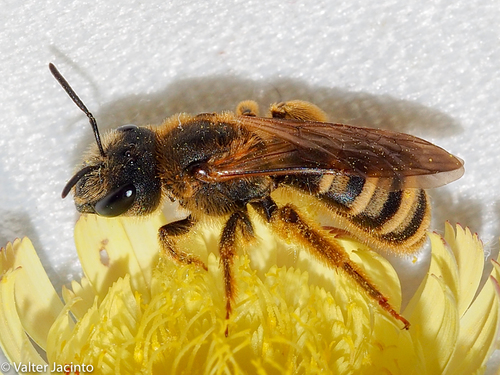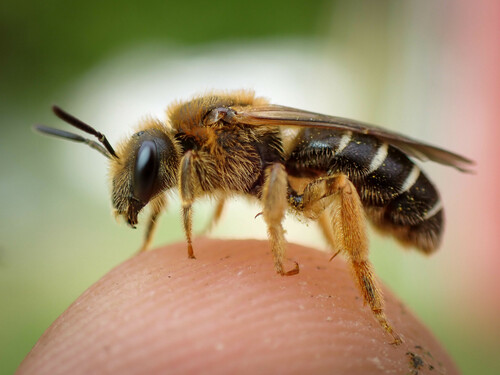
About Halictus rubicundus (Christ, 1791)
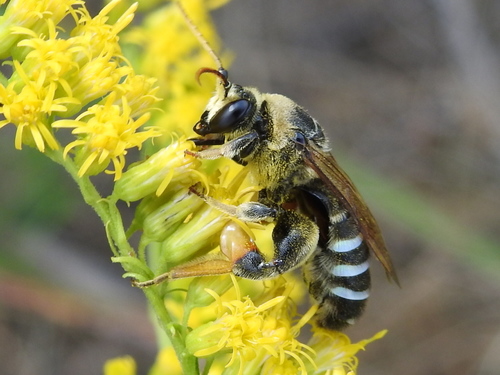
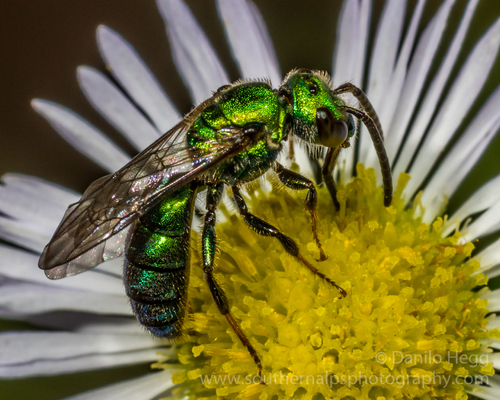
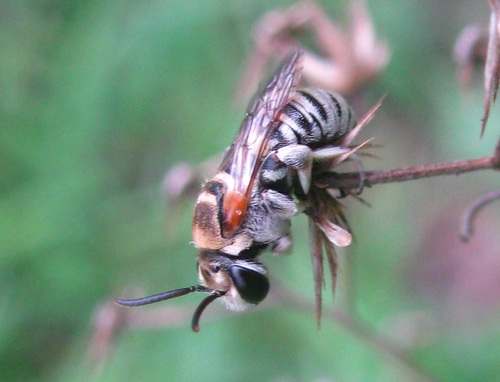
Description and identification: While many species in the Halictidae family have a metallic appearance, Halictus rubicundus is non-metallic. Female Halictus rubicundus are approximately 1 cm long and brown, with fine white bands across the apices of their abdominal segments, and rusty-orange legs. Males have a more slender body, longer antennae, and yellow markings on the face and legs; they can be told apart from males of similar species by the lack of an apical hair band on their terminal abdominal segment. In social populations, females from the first brood, which are mostly workers, can be identified by their typically slightly smaller size compared to the original foundress females. Distribution and habitat: H. rubicundus has one of the broadest natural distributions of any bee species, found across all temperate regions of the Holarctic. It is thought that climate differences across this large range drive variation in the species' social behavior. Populations in more northern locations or at higher elevations are generally more solitary in behavior than populations in southern locations or at lower elevations. This variation is widely studied, as it offers insight into the evolutionary transition from solitary to social behavior. Nests of this species are haplometrotic, meaning they are founded by a single female. Social populations typically occur in warmer regions, such as Kansas, while solitary populations nest in cooler regions including Colorado, Scotland, and Alaska. In intermediate regions such as New York and southern Ontario, both social and solitary behavior can be found in different nests within the same population. The strictly solitary behavior pattern develops in response to colder environments, because the annual active season is too short to support producing two separate broods.