About Haliastur indus (Boddaert, 1783)
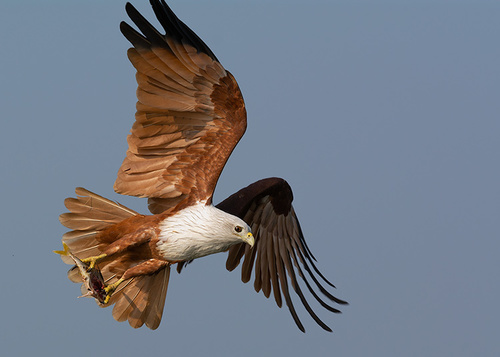
The brahminy kite, Haliastur indus (Boddaert, 1783), has a distinct contrasting plumage: it is chestnut overall, with a white head and breast, and black wing tips. Juvenile brahminy kites are browner than adults. They can be told apart from both resident and migratory Asian races of black kites by their paler overall appearance, shorter wings, and rounded tail. A distinct pale squarish patch on the underwing carpal region separates this species from Buteo buzzards. Brahminy kites are roughly the same size as black kites (Milvus migrans), and have the characteristic angled-wing flight of kites. Unlike Milvus species including red kites and black kites, which have forked tails, the brahminy kite has a rounded tail, even though the two genera are very closely related. The call of the brahminy kite is a mewing keeyew. This species is widespread and resident across its range, which includes the skies of Sri Lanka, Nepal, India, Iran, Pakistan, Bangladesh, southeast Asia, and extends as far south as New South Wales, Australia. In some parts of their range, brahminy kites make seasonal movements linked to rainfall. They are most commonly found in plains, but may sometimes occur at elevations above 5000 feet in the Himalayas. The brahminy kite is listed as Least Concern on the IUCN Red List of Threatened Species, though populations are declining in some areas such as Java.