About Haliaeetus vociferoides Des Murs, 1845
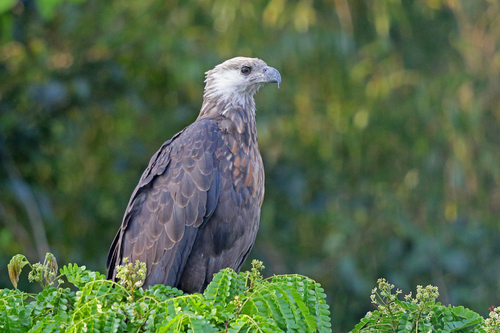
The Madagascar fish eagle (scientific name Haliaeetus vociferoides Des Murs, 1845) is a medium-sized sea eagle. It measures 60–66 cm (23.5–26 in) in length, with a wingspan of 165–180 cm (65–71 in). Males weigh 2.2–2.6 kg (4.9–5.7 lb), while the slightly larger females weigh 2.8–3.5 kg (6.2–7.7 lb). Its body and wings are dark brown, with a pale brown head, a white tail, a blackish bill with a paler base, and pale grey legs. Its closest relative is the African fish eagle, Icthyophaga vocifer. The two species form a distinct species pair lineage of sea-eagles that separated soon after the divergence of the genus. They retain the ancestral dark beak, talon, and eye, but unlike other Haliaeetus species, they always have at least a partially white tail even in their juvenile stage. As with other sea-eagle species pairs, one species, the Madagascar fish eagle in this case, has a tan head, while the African fish eagle has a white head. This species is also known to show polyandrous breeding behavior, meaning a single female mates with two males. A study carried out in the Tsimembo-Manambolomaty Protected Area recorded multiple polyandrous pairs, which had higher reproductive success than monogamous pairs (Razafimanjato et al., 2018). This species is endemic to Madagascar, with small surviving populations along the northwest coast north of Morondava. Its range falls within the Madagascar dry deciduous forests. According to the United Nations Environmental Programme, the main population center is in the Analova region, where there were 20 to 25 breeding pairs as of the 1980s. A more recent survey by Garbutt and Hogan recorded a smaller concentration of at least three breeding pairs in the Anjajavy Forest along the Indian Ocean, where several streams discharge north of Anjajavy Village.