About Haliaeetus vocifer (Daudin, 1800)
The African fish eagle (Haliaeetus vocifer) is a large bird of prey that displays typical avian sexual dimorphism, with females larger than males. Females weigh 3.2–3.6 kg (7.1–7.9 lb) and have an average wingspan of 2.4 m (7.9 ft), while males weigh 2.0–2.5 kg (4.4–5.5 lb) and have an average wingspan of around 2.0 m (6.6 ft). Adult body length ranges from 63–75 cm (25–29.5 in).
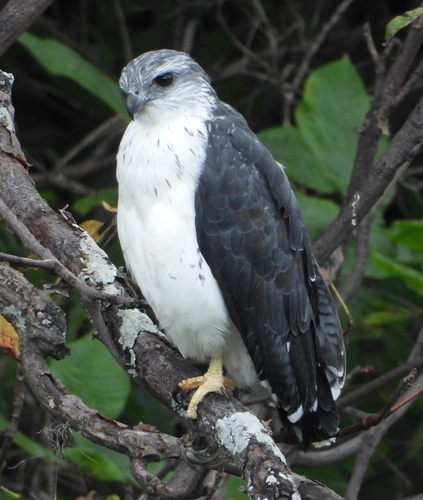
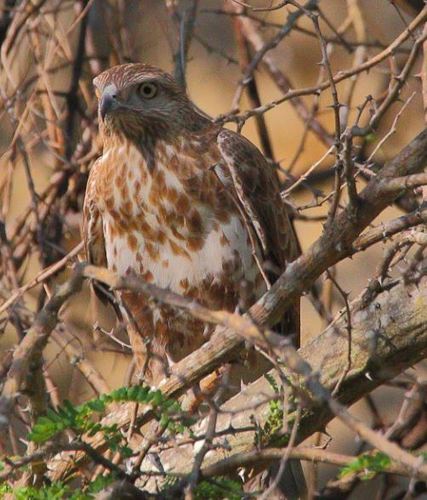
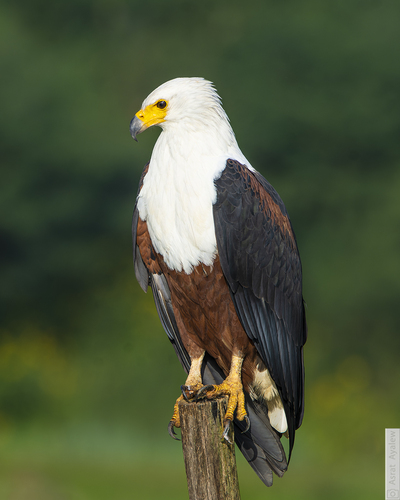
Adult African fish eagles have a very distinct appearance: most of the body is brown, with black, large and powerful wings. The head, breast, and tail are snow white; the only exception is the featherless yellow face. Their eyes are dark brown, and their hook-shaped yellow beak (adapted for a carnivorous diet) has a black tip. Juveniles have entirely brown plumage and paler eyes than adults. The species' feet have rough soles and strong talons, which help them grip slippery aquatic prey.
While African fish eagles feed mainly on fish, they are opportunistic hunters that will take a wider range of prey including waterbirds. Their distinctive cry is widely considered to evoke the spirit of Africa; male calls are shriller, and are described as weee-ah, hyo-hyo or heee-ah, heeah-heeah.
African fish eagles are native to sub-Saharan Africa, and are found across most of continental Africa south of the Sahara Desert. They remain quite common near freshwater lakes, reservoirs, and rivers, though they can sometimes also be found near the coast at river mouths or lagoons. They are known to be resident in sites including the Orange River (shared by South Africa and Namibia), the Okavango Delta in Botswana, and Lake Malawi (bordering Malawi, Tanzania, and Mozambique). Substantial populations are thought to occur around Lake Victoria and other large Central African lakes, especially Rift Valley lakes.
This generalist species only requires open water with enough prey and a suitable perch, so it can survive in a wide range of habitat types: grasslands, swamps, marshes, tropical rainforests, fynbos, and even desert-bordering coastlines like that of Namibia. It is not found in arid areas with very little surface water.
African fish eagles breed during the dry season, when water levels are low. They typically mate for life. Breeding pairs usually maintain two or more nests that they reuse repeatedly. Because nests are added to each year they are reused, they can grow very large; some reach 2.0 m (6.5 ft) across and 1.2 m (3.9 ft) deep. Nests are built mostly from sticks and other wood, and placed in large trees.
Females lay 1 to 3 eggs, which are mostly white with a small number of reddish speckles. Incubation is primarily performed by the female, though the male will take over when the female leaves to hunt. Incubation lasts 42 to 45 days before the chicks hatch. Siblicide is not common in this species, and parents often successfully raise two or three chicks. Chicks fledge at around 70 to 75 days old, and remain dependent on their parents for up to three months after fledging. After this period, juveniles become nomadic and may gather in groups separate from territorial adult eagles. Individuals that survive their first year have a life expectancy of 12 to 24 years.