About Haliaeetus pelagicus (Pallas, 1811)
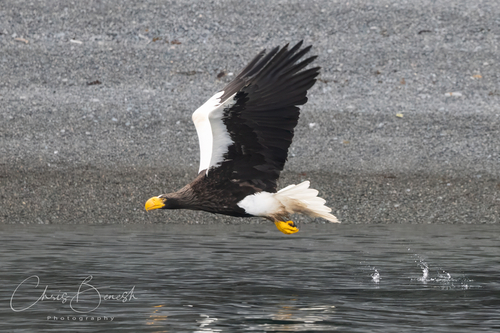
Steller's sea eagle (scientific name Haliaeetus pelagicus, described by Peter Simon Pallas in 1811), also called the Pacific sea eagle or white-shouldered eagle, is a very large diurnal bird of prey in the family Accipitridae. No subspecies are recognized. A sturdy eagle, it has dark brown plumage with white wings and tail, plus a yellow beak and yellow talons. Like most other raptors, female Steller's sea eagles are larger than males. It is typically ranked as the heaviest eagle in the world, with a body mass ranging from 5 to 10 kg (11 to 22 lb), but may be placed below the harpy eagle (Harpia harpyja) and Philippine eagle (Pithecophaga jefferyi) when measured by some other standard measurements. The species is endemic to coastal northeastern Asia, occurring in Russia, Korea, Japan, and China. Its main prey is fish and water birds. The Kamchatka Peninsula in Far Eastern Russia hosts a relatively large population of these eagles, with roughly 4,000 individuals living there. Steller's sea eagle is listed as Vulnerable on the International Union for Conservation of Nature Red List of threatened species. Steller's sea eagle breeds on Russia's Kamchatka Peninsula, the coastal area around the Sea of Okhotsk, the lower reaches of the Amur River, and on northern Sakhalin and the Shantar Islands. Most eagles leave their breeding grounds to winter south of this range, in Russia's southern Kuril Islands and Japan's Hokkaidō; many wintering individuals go on to Korea, Japan, and China. Compared to the white-tailed eagle, Steller's sea eagle is less prone to vagrancy, as it lacks the long-range juvenile dispersal that is typical of white-tailed eagles. Even so, vagrant Steller's sea eagles have been recorded in North America, including the Aleutian Islands, Pribilof Islands, Kodiak Island, and single individuals have been sighted in Texas, Nova Scotia, Massachusetts, Maine, and Newfoundland. In inland Asia, vagrants have been found as far north and inland as Yakutsk in Russia's Sakha Republic and as far south as Beijing, China and Taiwan. The species' large body size and native distribution lead to the suggestion that it is a glacial relict: it evolved in a narrow subarctic zone along the northeasternmost Asian coasts, which shifted latitude in response to ice age cycles, and the species never naturally occurred anywhere else. Steller's sea eagles build their nests on large rocky outcroppings or at the tops of large trees along coasts and large rivers with mature trees. They prefer habitats that contain large Erman's birches (Betula ermanii) and floodplain forests of larches, alders, willows, and poplars. Some eagles, especially those that nest on seacoasts, do not migrate. The timing, duration, and extent of annual migration depends on local ice conditions and food availability. On Kamchatka, eagles overwinter in forests and river valleys near the coast, and are irregularly distributed across the peninsula; most wintering birds here are resident adults. Migratory eagles fly south to winter in rivers and wetlands in Japan, and occasionally move to mountainous inland areas instead of seacoasts. Each winter, drifting ice on the Sea of Okhotsk pushes thousands of eagles southward; ice reaches Hokkaido in late January, and eagle numbers peak in the Nemuro Strait in late February. On Hokkaido, Steller's sea eagles gather in coastal areas and near-coastal lakes, alongside substantial numbers of white-tailed eagles. The eagles depart for their breeding grounds between late March and late April, with adults typically leaving before immature eagles. Migrants generally follow coastlines and are most often seen flying alone. When flying in groups, individual migrants typically stay 100–200 m (330–660 ft) apart. On Kamchatka, most migrating individuals are birds with transitional plumages. Steller's sea eagles are occasionally seen flying over the northern ocean or perching on sea ice during the winter. This species builds multiple bulky stick nests (called aeries) that can grow up to 1.5 m (59 in) high and 2.5 m (98 in) in diameter. Nests are usually placed 15 to 20 m (49 to 66 ft) above the ground, high on trees or on rocky outcroppings; they may occasionally be placed as high as 45 m (148 ft) up in trees. Alternate nests used by the same pair are usually built within 900 m (3,000 ft) of each other; in one recorded case, two active nests were found just 100 m (330 ft) apart. Courtship usually takes place between February and March, and consists of a simple soaring flight above the breeding area. It was long believed that mated pairs stay together for life, but molecular genetic studies have found that some chicks have unexpectedly high genetic similarity to chicks from other nests. This has been suggested as evidence of occasional polygamy in this colonially nesting species, though an alternative hypothesis notes that the parents of these so-called "conditional" siblings could simply be close relatives. Steller's sea eagles copulate on the nest after completing nest construction. The first greenish-white eggs are laid around April to May. Eggs measure 78 to 85 mm (3.1 to 3.3 in) in height, 57.5 to 64.5 mm (2.26 to 2.54 in) in width, and weigh around 160 g (5.6 oz), making them slightly larger than the eggs of harpy eagles. Clutches hold 1 to 3 eggs, with two being the average. Usually, only one chick survives to adulthood, though in some cases up to three chicks will successfully fledge. Chicks hatch after an incubation period of 39 to 45 days. Hatchlings are altricial and covered in whitish down when they emerge. Eaglets fledge in August or early September. They reach full adult plumage at four years of age, and typically do not breed for the first time until one or two years later. Eggs and very small nestlings may be preyed on by arboreal mammals such as sables and ermines, and by small birds, usually corvids. All of these small, opportunistic nest predators rely on distraction and stealth to access nests, and are killed if caught by either parent. Once chicks reach roughly adult size at the fledgling stage, few predators can threaten this species. There is one recorded case of a brown bear (Ursus arctos) accessing a nest on a rock formation and eating a fledgling eaglet, though this is considered exceptional. Fully grown fledglings in tree nests are likely invulnerable to predation. Excluding the Asian black bear (Ursus thibetanus), which has never been recorded preying on this species, no other mammalian carnivore of equal or greater size can climb trees within Steller's sea eagle's native range. Primarily due to egg predation and nest collapses, only 45–67% of eggs successfully produce a mature adult, and up to 25% of hatched nestlings are lost before reaching adulthood. Once the eagle is fully grown, it has no natural predators.