About Haliaeetus leucogaster (Gmelin, 1788)
Scientific name: Haliaeetus leucogaster (Gmelin, 1788)
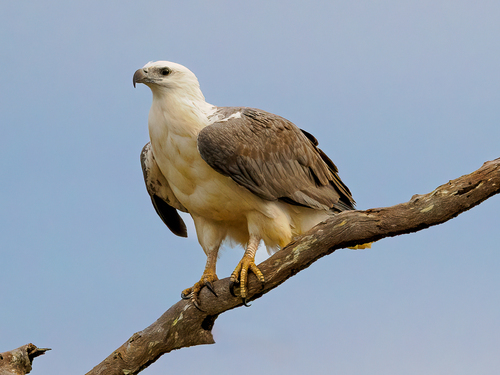
The white-bellied sea eagle has a white head, rump and underparts, with dark or slate-grey back and wings. When seen from below in flight, the black flight feathers on the wings are easily visible. Its large, hooked bill is leaden blue-grey with a darker tip, the irides are dark brown, and the cere is also lead grey. The legs and feet are yellow or grey, with long black talons (claws). Unlike the legs of eagles in the genus Aquila, the legs of the white-bellied sea eagle are not feathered.
The sexes are similar in appearance. Males are 66–80 cm (26–31 in) long and weigh 1.8–3 kg (4.0–6.6 lb). Females are slightly larger, measuring 80–90 cm (31–35 in) long and weighing 2.5–4.5 kg (5.5–9.9 lb). The wingspan of this species ranges from 1.78 to 2.2 m (5.8 to 7.2 ft). A 2004 study of 37 birds from Australia and Papua New Guinea (3 °S to 50 °S) found that birds could be reliably sexed by size, and that birds from further southern latitudes were larger than those from the north. There is no seasonal variation in plumage. The moulting pattern of the white-bellied sea eagle is poorly understood; it appears to take longer than a year to complete, and can be interrupted and later resumed from the point of interruption.
When gliding, the wings are held so that they rise from the body at an angle, and are closer to horizontal along the outer portion of the wingspan. In silhouette, the bird's comparatively long neck, head and beak protrude forward almost as far as the tail extends behind the body. During active flight, the white-bellied sea eagle alternates strong, deep wing beats with short periods of gliding.
A juvenile white-bellied sea eagle in its first year is predominantly brown, with pale cream-streaked plumage on the head, neck, nape and rump. Plumage becomes increasingly mixed with white until the bird gains full adult plumage by the fourth or fifth year. This species begins breeding at around six years of age, and its lifespan is thought to be around 30 years.
The white-bellied sea eagle has a loud goose-like honking call, which is a well-known sound, particularly during the breeding season. Pairs often honk in unison, and will frequently call for extended periods while perched. The male's call is higher-pitched and more rapid than the female's. Australian naturalist David Fleay observed that this call is among the loudest and furthest-carrying of all Australian bird calls, which is in stark contrast to the relatively quiet calls of the wedge-tailed eagle.
Adult white-bellied sea eagles have a distinct appearance and are unlikely to be confused with any other bird. Immature birds can be confused with wedge-tailed eagles, but wedge-tailed eagles have darker plumage, a longer tail, and feathered legs. Immatures may also be confused with the black-breasted buzzard (Hamirostra melanosternon), but this species is much smaller, has white patches on the wings, and has a more undulating flight pattern. In India, the Egyptian vulture has white plumage, but it is smaller and has a whiter back and wings. The white tail of the white-bellied sea eagle visible in flight distinguishes it from other species of large eagles. In the Philippines, it can be confused with the Philippine eagle, which can be told apart by its crest; immature white-bellied sea eagles resemble immature grey-headed fish eagles, but can be identified by their more fully dark brown underparts and flight feathers, and their wedge-shaped tail.
The white-bellied sea eagle is found regularly from Mumbai (sometimes as far north as Gujarat, and historically in the Lakshadweep Islands) eastward across India, Bangladesh, and Sri Lanka in southern Asia, through all of coastal Southeast Asia including Burma, Thailand, Malaysia, Indonesia, Indochina, the main and offshore islands of the Philippines, and southern China including Hong Kong, Hainan and Fuzhou, and continues east through New Guinea, the Bismarck Archipelago, and Australia. In the northern Solomons it is restricted to Nissan Island, and replaced elsewhere by Sanford's sea eagle. In Victoria, where it is otherwise scarce, it is locally more common at Corner Inlet and Gippsland Lakes. Similarly in South Australia, it is most abundant along the north coast of Kangaroo Island. Its range extends to the islands of Bass Strait and Tasmania, and it is thought able to move between the islands and the mainland. There is one unconfirmed record from Lord Howe Island and several from New Zealand.
White-bellied sea eagles are a common sight in coastal areas, but may also be seen far inland (it has reportedly been seen at Panna Tiger Reserve in central India, nearly 1,000 km (621 mi) from the sea). The species is generally sedentary and territorial, though it may travel long distances. It has been reported travelling upriver to hunt for flying foxes (Pteropus). Populations in inland Australia move around as inland bodies of water form and then dry up. In one recorded case, a pair came to breed at Lake Albacutya in northwestern Victoria after the lake had been empty for 30 years. The species is easily disturbed by humans, especially when nesting, and may abandon nesting sites as a result. It is found in greater numbers in areas with little or no human impact or interference.