About Haliaeetus leucocephalus (Linnaeus, 1766)
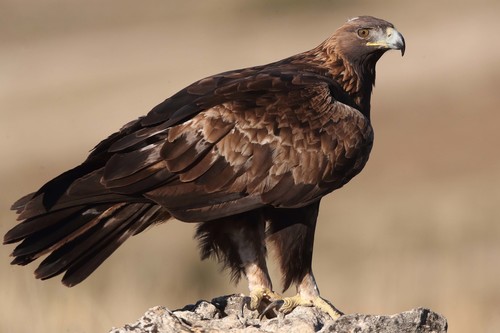
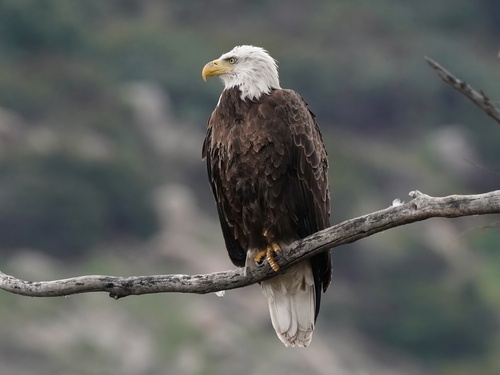
Adult bald eagles (Haliaeetus leucocephalus) have uniformly dark brown plumage, with white heads and white, moderately long, slightly wedge-shaped tails. Males and females have identical plumage color, but the species shows clear sexual dimorphism: females are 25% larger than males. The beak, feet, and irises are bright yellow; legs are unfeathered, and toes are short and powerful with large talons. The well-developed talon on the hind toe pierces prey’s vital areas while the front toes hold the prey still. The beak is large and hooked, with a yellow cere. Adult bald eagles are easily recognizable within their native range. The African fish eagle, which lives far outside the bald eagle’s range, also has a brown body (with a more rufous tone), white head, and white tail, but it differs from the bald eagle by having a white chest and a black-tipped bill. Immature bald eagles have dark brown plumage covered with uneven white streaking until they reach sexual maturity at 5 years old (rarely at 4, very rarely at 3). In North America, the only other large non-vulturine raptor besides the bald eagle is the golden eagle (Aquila chrysaetos). Immature bald eagles can be told apart from golden eagles by their larger, more protruding head, larger beak, straighter-edged wings held flat (not slightly raised) with a stiffer wing beat, and legs that are not fully covered in feathers. When clearly seen, golden eagles have a more uniform warm brown plumage than immature bald eagles, with a reddish-golden patch on the nape and, in immature birds, strongly contrasting white wing patches. The bald eagle is sometimes considered the largest true accipitrid raptor in North America. The only larger raptor-like bird is the California condor, a New World vulture not generally classified as a true accipitrid. The American subspecies of golden eagle averages 4.18 kg in body mass and 63 cm in wing chord length, only 455 g lighter than the average bald eagle, and has an average wing chord around 3 cm longer than that of the bald eagle. Rarely, two close relatives of the bald eagle – the longer-winged, shorter-tailed white-tailed eagle and the larger overall Steller's sea eagle – may wander to coastal Alaska from Asia. The bald eagle has a total body length of 70–102 cm, a typical wingspan of 1.8–2.3 m, and a body mass of 3–6.3 kg. Females average up to 5.6 kg, while males average 4.1 kg, making females around 25% larger. Body size varies by location and generally follows Bergmann’s rule: the species grows larger further from the equator and tropics. For example, bald eagles from South Carolina average 3.27 kg and 1.88 m wingspan, smaller than northern conspecifics; a Florida field guide recorded similarly small sizes around 4.13 kg. A sample of 117 migrant bald eagles in Glacier National Park averaged 4.22 kg, a result likely lowered by mostly post-dispersal juveniles; six adults from this group averaged 4.3 kg. Wintering bald eagles in Arizona, where winter weights are usually the highest annually since raptors spend more time foraging in winter, averaged 4.74 kg. The largest bald eagles are from Alaska, where large females may weigh over 7 kg and have a 2.44 m wingspan. A survey of Alaskan adults found average masses of 5.35 kg for females and 4.23 kg for males; immature Alaskan bald eagles averaged 5.09 kg (females) and 4.05 kg (males). One exceptionally large Alaskan adult female weighed 7.4 kg, and a 1876 record from R.S. Palmer cites an adult shot in Wyoming County, New York that reportedly weighed 8.2 kg. Standard linear measurements are: wing chord 51.5–69 cm, tail 23–37 cm, tarsus 8–11 cm. Culmen length ranges from 3 to 7.5 cm, while the measurement from gape to bill tip is 7–9 cm. Bill size varies greatly: Alaskan bald eagles can have a culmen twice as long as that of southern U.S. birds from Georgia, Louisiana, and Florida, with average culmen lengths of 6.83 cm (Alaska) and 4.12 cm (southern U.S.). The bald eagle’s call is a series of weak, staccato, chirping whistles transcribed as kleek kik ik ik ik, with a cadence similar to a gull’s call. Young birds produce harsher, shriller calls than adults. The bald eagle’s natural range covers most of North America, including most of Canada, all of the contiguous United States, and northern Mexico. It is the only sea eagle endemic to North America. It occupies a wide range of habitats, from Louisiana bayous to the Sonoran Desert to the deciduous forests of eastern Quebec and New England. Northern bald eagles are migratory, while southern birds are resident and stay on their breeding territory year-round. At its minimum population size in the 1950s, the species was mostly limited to Alaska, the Aleutian Islands, northern and eastern Canada, and Florida. Bald eagle numbers increased substantially across both winter and breeding ranges from 1966 to 2015, and as of 2018, the species nests in every contiguous U.S. state and Canadian province. Most Canadian bald eagles live along the British Columbia coast, with large populations also found in the forests of Alberta, Saskatchewan, Manitoba, and Ontario. Bald eagles gather in specific winter locations: 1,000 to 2,000 winter in Squamish, British Columbia between November and February, gathering along the Squamish and Cheakamus Rivers to feed on spawning salmon. Similar winter gatherings of bald eagles occur at open lakes and rivers with accessible fish for hunting or scavenging in the northern United States. In March 2024, bald eagles were recorded nesting in Toronto for the first time. The species has occurred as a vagrant twice in Ireland: a juvenile was illegally shot in County Fermanagh in 1973 (first misidentified as a white-tailed eagle), and an exhausted juvenile was captured near Castleisland, County Kerry in 1987. There is also a 1978 record of a bald eagle at Llyn Coron, Anglesey, United Kingdom, though the origin of this individual is still disputed. During the breeding season, bald eagles occur in nearly any type of American wetland habitat, including seacoasts, rivers, large lakes, and marshes, preferring large open water bodies with abundant fish. Studies show they prefer water bodies with a circumference over 11 km, and lakes over 10 km² are optimal for breeding. Bald eagles typically need mature, old-growth stands of coniferous or hardwood trees for perching, roosting, and nesting. Tree height, structure, and location are more important to breeding pairs than tree species. Abundant large trees surrounding open water is a key habitat requirement. Selected nesting trees must have good visibility, be over 20 m tall, have an open structure, and be close to prey. Nests in standing water (such as mangrove swamps) can be as low as 6 m above ground; in dry-ground trees, nests are usually 16–38 m high. Average nesting tree dimensions vary by region: 82 cm diameter, 28 m tall in Chesapeake Bay; 23 m tall, 23 cm diameter in Florida; and 27 m tall in the Greater Yellowstone area. Nesting forests should have a canopy cover between 20% and 60%, and most nests are found within 200 m of open water. The farthest recorded distance from open water for a bald eagle nest is over 3 km, in Florida. Bald eagle nests are very large to accommodate the birds. The largest recorded nest, found in Florida in 1963, measured 2.9 m wide and 6.1 m deep. In Florida, common nesting habitats include mangrove swamps, lake and river shorelines, pinelands, seasonally flooded flatwoods, hardwood swamps, and open prairies and pastureland with scattered tall trees. Favored nesting trees in Florida are slash pines, longleaf pines, loblolly pines, and cypress trees, with mangroves typically used on the southern coast. In Wyoming, mature cottonwood groves or tall pines along streams and rivers are typical nesting habitat, with bald eagles using habitats ranging from large old-growth ponderosa pine stands to narrow riparian tree strips surrounded by rangeland. In southeast Alaska, 78% of nesting trees are Sitka spruce, with 20% being hemlocks. Bald eagles increasingly nest near human-made reservoirs stocked with fish. Bald eagles are usually sensitive to human activity while nesting, and are most often found in areas with minimal human disturbance. They generally choose nesting sites more than 1.2 km from low-density human disturbance and more than 1.8 km from medium- to high-density human disturbance. However, bald eagles occasionally nest in large estuaries or secluded groves within major cities, such as Hardtack Island on the Willamette River in Portland, Oregon, or John Heinz National Wildlife Refuge at Tinicum in Philadelphia, Pennsylvania, which are surrounded by extensive human activity. Even more unusually, a pair of bald eagles established a nest in the Harlem neighborhood of New York City in 2010. During winter, bald eagles are less sensitive to habitat and disturbance. They often gather at spots with plentiful perches and prey, and prefer partially unfrozen water in colder climates. Non-breeding or wintering bald eagles, especially in undisturbed areas, may use upland terrestrial habitats sometimes far from waterways. This is particularly common in the northern half of North America (especially the interior), where unfrozen water may not be available. Upland winter habitats are usually open areas with concentrations of medium-sized mammals, such as prairies, meadows, or tundra, or open forests with regular access to carrion. Bald eagles reach sexual maturity at 4 or 5 years old, and mature individuals often return to their birth area to breed. They have high mate fidelity and generally mate for life. If one pair member dies or disappears, the survivor will take a new mate; pairs with repeated breeding failure may split and find new mates. Courtship involves elaborate, dramatic calls and flight displays from the male, including swoops, chases, and cartwheeling: the pair flies high, locks talons, free-falls, and separates just before hitting the ground. A mature breeding pair usually defends a 1 to 2 km stretch of waterside habitat. Unlike most raptors, which nest in April or May, bald eagles breed early. Nest building or reinforcing is complete by mid-February, egg laying usually occurs in late February (sometimes during deep snow in the North), and incubation runs from mid-March to early May. Eggs hatch from mid-April to early May, and young fledge from late June to early July. The bald eagle builds the largest nest of any North American bird. Nests are reused for many years, with new material added each year, and may eventually reach 4 m deep, 2.5 m across, and weigh 1 metric ton. One Florida nest measured 6.1 m deep, 2.9 m across, and weighed 2.7 metric tons, which is the largest tree nest ever recorded for any animal. Most nests are used for fewer than five years, as they often collapse in storms or break supporting branches under their weight, but one Midwest nest was occupied continuously for at least 34 years. Nests are built from branches, usually in large trees near water. Where no trees are available, bald eagles will nest on the ground, which has been recorded mostly in predator-isolated areas such as Amchitka Island, Alaska. In Sonora, Mexico, bald eagles have been observed nesting on top of cardón cactuses (Pachycereus pectin-aboriginum). Historical reports note nests on cliffs and rock pinnacles in California, Kansas, Nevada, New Mexico, and Utah, but currently this is only verified in Alaska and Arizona. Bald eagle eggs average 73 mm long (range 58–85 mm) and 54 mm wide (range 47–63 mm). Alaskan eggs average 130 g, while Saskatchewan eggs average 114.4 g; egg size, like adult body size, increases with distance from the equator. Bald eagles lay 1 to 3 eggs per year, with 2 being typical. Four eggs are rarely found, and may be an exceptional case of polygyny; captive bald eagles can produce up to seven eggs. It is rare for all three chicks to successfully fledge. The oldest chick has an advantage from its larger size and louder calls that attract more parental attention. As recorded in many large raptors, the oldest sibling occasionally attacks and kills younger siblings, especially early in the nesting period when size differences are greatest. Still, nearly half of all studied bald eagle pairs produce two fledglings (more rarely three), which is a higher rate than seen in some Aquila eagles, where a second fledgling is observed in less than 20% of nests despite two eggs typically being laid. Both parents take turns incubating eggs, though the female does most of the incubation. The non-incubating parent hunts for food or collects nesting material. For the first two to three weeks after hatching, at least one adult is almost constantly at the nest. After five to six weeks, parental attendance at the nest drops considerably, with parents usually perching in nearby trees. Nestling eaglets can gain up to 170 g per day, the fastest growth rate of any North American bird. Young eaglets manipulate sticks, play tug of war with each other, practice holding objects with their talons, and stretch and flap their wings. By eight weeks old, eaglets are strong enough to flap their wings, lift their bodies off the nest platform, and rise into the air. Young fledge between 8 and 14 weeks after hatching, but remain near the nest and are cared for by their parents for an additional six weeks. Juveniles begin dispersing from their parents around eight weeks after fledging, with departure dates varying based on sex and hatching order effects on growth and development. Immature bald eagles wander widely in search of food for the next four years, until they develop adult plumage and reach breeding age. Male bald eagles have been observed killing and cannibalizing their chicks. In 2024, the Eagle Cam at the National Conservation Training Center (NCTC) in West Virginia recorded a father bald eagle attacking and eating two of his chicks immediately after the mother left the nest. NCTC stated that this behavior has been observed in other nests and is not uncommon among birds of prey. On rare occasions, bald eagles have been recorded adopting other raptor fledglings into their nests. In 2017, a pair in the Shoal Harbor Migratory Bird Sanctuary near Sidney, British Columbia reportedly brought a juvenile red-tailed hawk back to the nest, presumably as prey, but the chick was accepted by both the adult eagles and their three nestlings. The hawk, nicknamed "Spunky" by monitoring biologists, fledged successfully.