About Haliaeetus albicilla (Linnaeus, 1758)
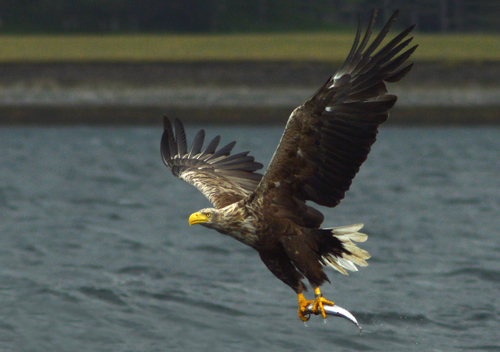
Identification: Adult white - tailed eagles are easily distinguishable from other birds under reasonable viewing conditions. In their range, no other eagles have fully white tails, except in the easternmost areas where the bald eagle and Steller's sea eagle may be present. Adult bald and Steller's sea eagles differ in plumage from white - tailed eagles. In poor light, bald eagles show a sharp white - to - dark - brown demarcation, while white - tailed eagles have a subtler contrast between their paler brown body and buff - coloured head. At a great distance, adult white - tailed eagles may be confused with Griffon vultures due to similar colouring and overlapping sizes, but vultures have a tiny head, curved trailing wing - edges, and more raised wings. Juveniles are harder to distinguish, mainly from other sea eagles in areas of overlap. In northern Mongolia, the Caspian Sea region, and parts of Kazakhstan, the white - tailed eagle may co - occur with Pallas's fish eagle. Pallas's juveniles have more whitish underwing markings, are smaller and slighter, and have a differently marked tail. White - tailed eagles are duller, darker, and browner overall. In the Aleutian islands and Alaska, bald eagle juveniles can be confused with white - tailed eagle juveniles, but bald eagles have a shorter neck, a longer and squarer tail, and less broad wings, and more extensive whitish mottling on the underside. Steller's sea eagles are larger, longer - tailed, and have a different wing shape, a more massive and paler bill. Juvenile Steller's sea eagles are darker than white - tailed eagles. The cinereous vulture is superficially similar to juvenile white - tailed eagles but is larger, longer - winged, with a more uniform and darker hue, paler legs, and a smaller head. Young white - tailed eagles may be confused with Aquila species, but their large wings, truncated and wedge - shaped tail, and obvious neck and head projection are distinctive. Some greater spotted eagles and eastern imperial eagles may seem similar in wing shape or profile but are smaller. Golden eagles are usually smaller, more dashing in flight, sleeker when perched, and have different plumage characteristics and tail shapes. Nest characteristics: White - tailed eagles often nest in large trees, preferably coniferous ones. Nests can be in high main forks, canopies, or large side branches. Access to food is crucial for nest location. In Germany, most nests were within 3 km of a lake, and 80% were in forests, often near open spaces. Only one cliff nest was recorded in Germany, and older records mention ground nests. Nest height varies by tree species and region. In Romania, it can be 15 - 25 m on black poplars and willows. In Hokkaido, nests are often in the tallest trees, 16.5 - 25 m above the ground. In eastern Germany, most nests were in mature pines. Nests can also be on crags, cliffs (in many regions, most nests are on cliffs), rarely on the ground, low hummocks, small trees, bushes, sand banks, or reed beds. One pair even nested on a buoy. Nests are usually large, made of sticks and branches, lined with various materials. The male often brings nesting branches, and the female is mainly responsible for construction. Nests may be added to as early as December but usually from March in high latitudes. Building a new nest may take months, but a lost nest can be rebuilt in less than a month. Repairing an existing nest takes about 18 days. White - tailed eagles may use nests built by other species, and their old nests may be used by other raptors. Many small bird species may nest near white - tailed eagle eyries. Pairs often build multiple nests and use them randomly over the years. Breeding range: This eagle breeds in northern Europe and northern Asia. Its range extends to southern Greenland, Iceland, reintroduced populations in parts of the UK and Ireland, and various parts of mainland Europe. It might have bred in the Faroe Islands in the past. In Anatolia, it breeds in small pockets in Turkey and Georgia. In the Middle East, it breeds along the southern coast of the Caspian Sea. In Kazakhstan, it is found in a strip in the southern part. In Russia, it is widespread, absent only from high - Arctic regions and a section bordering Kazakhstan. It also breeds in northern Mongolia, northwestern China, northern North Korea, Sakhalin Island, the Kuril Islands, and Hokkaido. Wintering range: The wintering range of white - tailed eagles is less clear due to historical population changes. Some winter in France, the Netherlands, western Germany, Denmark, and various parts of Europe. Vagrancy and migration occur in Turkey, the Levant, Iran, and other areas. In Asia, rare wintering areas are in Turkmenistan, Afghanistan, and other countries, and it is a rare winter visitor to India and parts of China, Myanmar, South Korea, and Japan. Some disperse to North America. Habitat: White - tailed eagles are usually associated with water and low - land areas, but can live at elevations of 1,500 - 2,300 m in Central Asia and Siberia if there is water access. They can be found in coastal areas, from high cliffs to low - lying islands, and often frequent low coastal spots in winter. They can switch between cliff and wooded nesting sites. Inland, they need secluded woods and access to freshwater wetlands. They may visit commercial fish farms but avoid areas with human disturbances. In some areas, they can forage and breed near human populations if well - protected.