About Halcyon leucocephala (P.L.S.Müller, 1776)
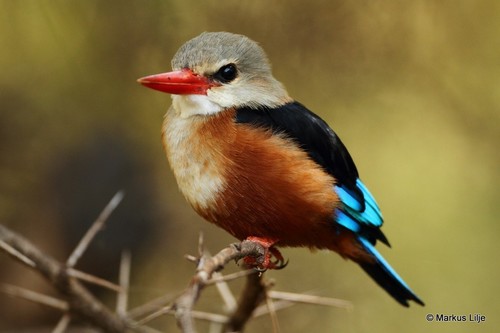
Males and females of this species look alike. Adult birds of the nominate subspecies H. l. leucocephala have a pale grey head, black mantle and back, bright blue rump, wings and tail, and chestnut-colored underparts. The subspecies H. l. pallidiventris has a darker grey head and paler chestnut underparts, but is otherwise identical to the nominate race. The species has a long, sharp, red beak. The average adult length is 21 cm (8.3 in).
The species' song is a sequence of notes that rise in pitch, fall, then rise again, growing progressively louder and sharper. Its warning call is a series of sharp notes, sounding like "tchk, tchk, tchk, tchk".
The grey-headed kingfisher is native to tropical and semi-tropical areas of Africa and the Arabian Peninsula. It has been recorded in Angola, Benin, Botswana, Burkina Faso, Burundi, Cameroon, Cape Verde, Central African Republic, Chad, Congo, Democratic Republic of Congo, Djibouti, Eritrea, Eswatini, Ethiopia, Gabon, Gambia, Ghana, Guinea, Guinea-Bissau, Iran, Ivory Coast, Kenya, Liberia, Malawi, Mali, Mauritania, Mozambique, Namibia, Niger, Nigeria, Oman, Rwanda, Saudi Arabia, Senegal, Sierra Leone, Somalia, South Africa, South Sudan, Sudan, Tanzania, Togo, Uganda, Yemen, Zambia and Zimbabwe. It typically lives in woodland, scrub, and cultivated areas, at elevations up to roughly 2,200 m (7,200 ft).
This is a dry-country kingfisher that inhabits scrub and woodland, and is found either alone or in pairs. It is often seen near water, but unlike most kingfisher species it does not live in aquatic habitats. It perches motionless on branches for long periods, watching the ground for insects or small lizards, and bobs its head before diving to catch its prey.
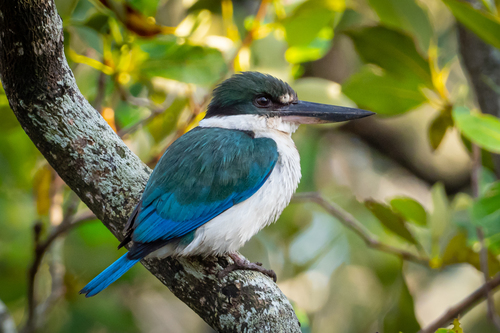
It closely resembles the brown-hooded kingfisher, but can be distinguished by its entirely red bill (the brown-hooded kingfisher has a red and black bill). It also looks similar to the woodland kingfisher, but the woodland kingfisher does not have a chestnut belly and has more cyan-colored feathers on its back. Grey-headed kingfishers nest in holes dug into steep riverbanks, and will aggressively defend their nests by repeatedly dive-bombing foraging monitor lizards. This species is parasitized by the greater honeyguide. It migrates at night, and many individuals die after colliding with manmade obstacles such as buildings, towers, and power lines.