About Hakea vittata R.Br.
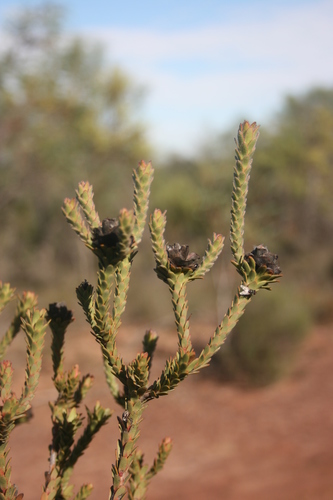
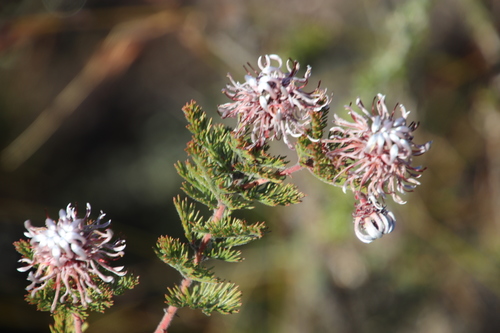
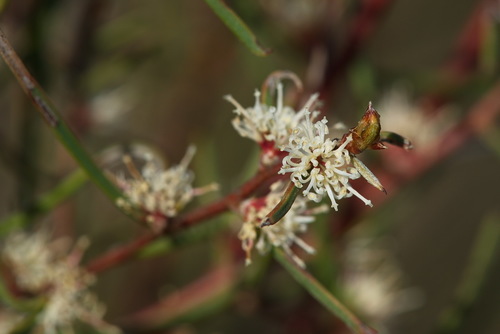
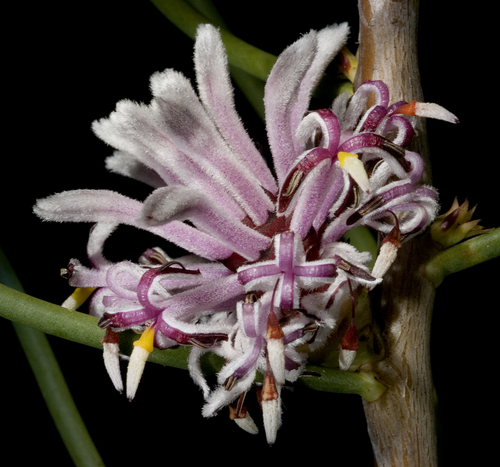
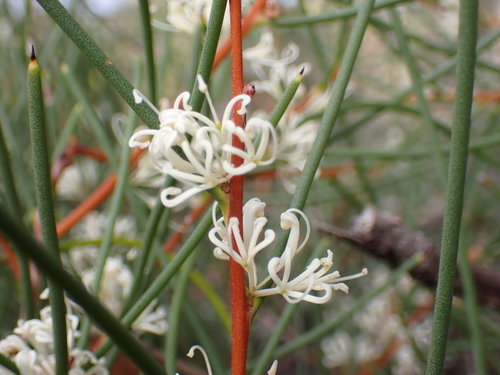
Hakea vittata R.Br. is a prostrate or straggly shrub that typically grows between 0.1 and 2 metres (0 to 7 ft) tall, and it forms a lignotuber. Its white, smooth branchlets are covered in short, soft hairs. The leaves are straight, smooth, and needle-like, measuring 2–8 cm (0.8–3 in) long and 0.8–1.5 mm (0.03–0.06 in) wide, and they end in a sharp point 1–2.5 mm (0.04–0.1 in) long. An inflorescence holding 8 to 14 reddish-white flowers grows from leaf axils. The main red-brown flower stalk is 0.5–3 mm (0.02–0.1 in) long, covered in short, flat-lying soft hairs. These hairs also extend to the individual flower stems, which measure 2.5–3.5 mm (0.1–0.01 in) long. Both the sepals and petals are white, and the style is 9.2–11.5 mm (0.4–0.5 in) long. The woody brown fruit can be smooth, wrinkled, or warty. It is egg-shaped, 1.3 to 2.4 cm (0.5 to 0.9 in) long and 0.9 to 1.5 cm (0.35 to 0.59 in) wide, ending in a small blister-like beak topped with short, prominent horns. Two features set Hakea vittata apart from other species in the Hakea genus: it develops "witches broom" galls, which are masses of dense shoots growing from a single point, and its fruit only splits past the seed tip along the side of the red-brown wood zone. Flowering takes place from August to November. This species, also commonly called hooked needle-wood, is found in southern regions of South Australia, including Kangaroo Island and Fleurieu Peninsula. It grows mostly in sandy mallee scrub on limestone.