About Hakea victoria Drumm.
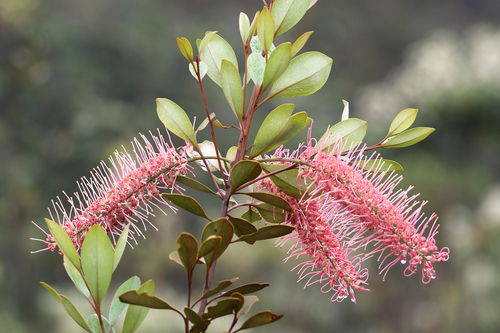
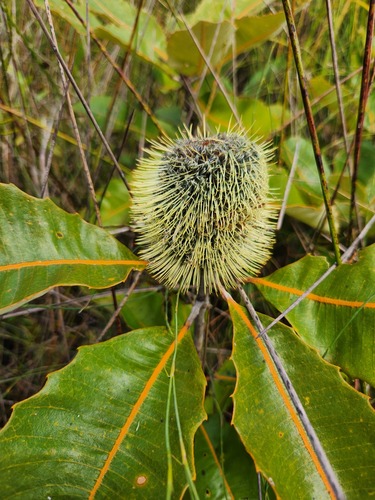
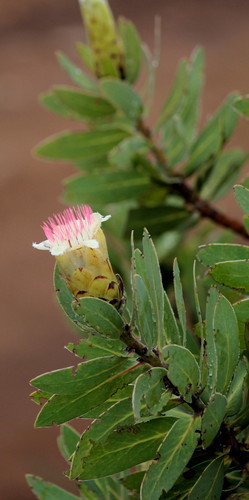
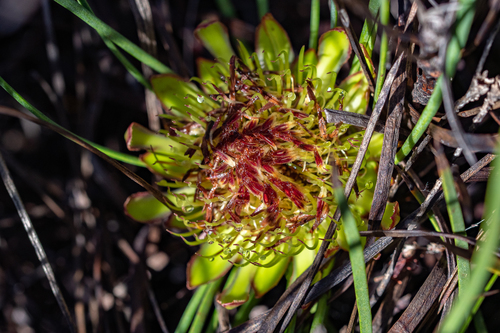
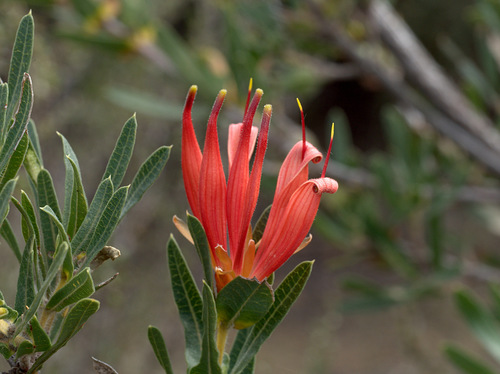
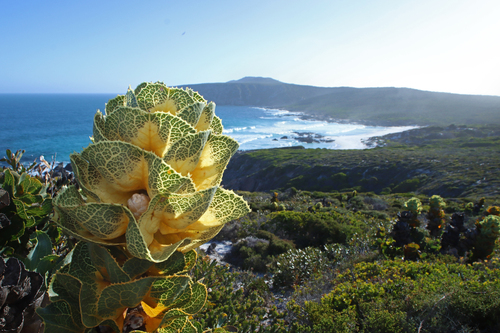
Hakea victoria has an erect, slender growth habit, reaching 1 to 3 metres (3 ft 3 in to 9 ft 10 in) tall and 1 metre (3 ft 3 in) wide. It produces very few branches and does not form a lignotuber. Its leaves are arranged alternately, measure 4 to 11.5 cm (1.6 to 4.5 in) long and 4 to 13 mm (0.16 to 0.51 in) wide, and have distinct visible veins on both their upper and lower surfaces. Leaves are rough, leathery, with wavy margins lined with prickly teeth, and end in a sharp point. Lower-positioned leaves are green and narrow, while upper-positioned leaves are broader, concave, roughly circular in shape, yellow at the base and shading to green at the tip. The inflorescence consists of a cluster of 26 to 42 small flowers, which may be cream-white, red or pink, that grow in leaf axils and are almost hidden by the shape of surrounding leaves. It has a smooth pedicel 6 to 11 mm (0.24 to 0.43 in) long, a pistil 33 to 37 mm (1.3 to 1.5 in) long, and a cream-coloured perianth. Flowering takes place from June to October. The woody fruits are roughly 25 mm (0.98 in) long and between 15 to 20 mm (0.59 to 0.79 in) wide, and each contains two winged seeds. The seed pods are serotinous, meaning they typically retain seeds until release is triggered by environmental factors such as bushfire. Royal hakea, the common name for this species, grows in quartzitic or lateritic sand, most often in rocky locations within the coastal region between Albany and Esperance in Western Australia, including the Fitzgerald River National Park. For horticultural use, Hakea victoria requires a well-drained, sunny growing location, and can tolerate moderate frost. This species does not grow well in humid conditions; even if plants survive in humid climates, their foliage will develop poor colour. Propagation is easy when done from seed, but it is quite difficult to propagate from cuttings.