About Hakea undulata R.Br.
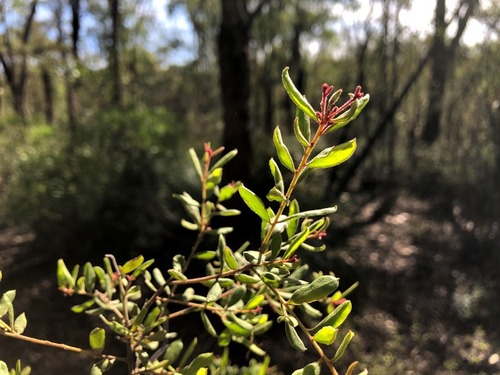
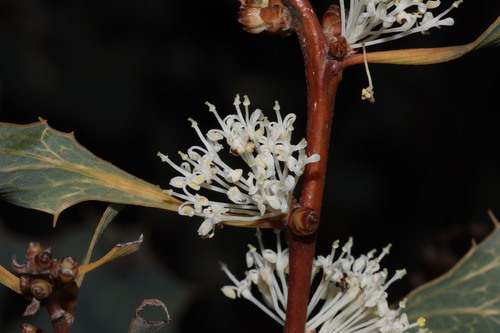
Hakea undulata R.Br., commonly called wavy-leaved hakea, is an erect, often straggly shrub that reaches 1 to 2 metres (3 to 7 feet) in height. This species does not form a lignotuber. By the time it flowers, its smaller branches are smooth. Its leaves range from elliptic to egg-shaped; they are stiff, prickly, have scalloped edges, and measure 4 to 12 centimetres (1.6 to 4.7 inches) long by 2 to 6 centimetres (0.79 to 2.36 inches) wide. The green-grey leaves have distinctive visible venation on both their upper and lower surfaces, and taper onto long stalks at the leaf base. The species produces single inflorescences arranged as a raceme, holding 12 to 21 sweetly scented cream-white flowers on smooth pedicels. The perianth is cream-white, and the pistil is 3 to 4 millimetres (0.12 to 0.16 inches) long. Its fruits are obliquely ovoid, 2 to 3 centimetres (0.8 to 1 inch) long by 1 to 2 centimetres (0.4 to 0.8 inch) wide. The fruit surface has smooth, slightly rough blister-like protrusions, and ends in an upturned beak. Flowering takes place from July to October. This species is distributed from the Darling Ranges north of Perth south to Albany. It grows in scrubland and woodland in sand, loam, and gravel, or in clay soil over laterite, and sometimes grows on granite. It requires a sunny position with good drainage, and is considered a good species for hedging and providing wildlife habitat.