About Hakea trifurcata (Sm.) R.Br.
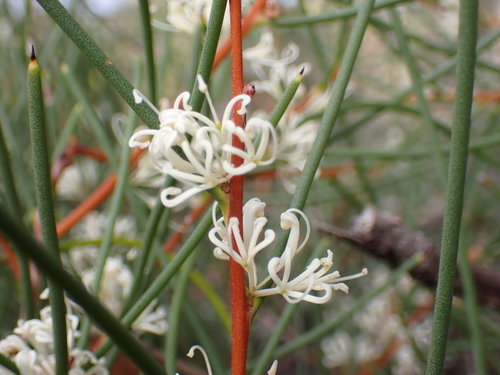
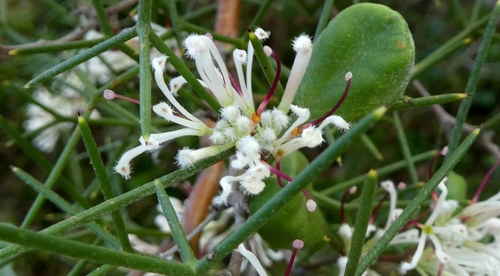
Hakea trifurcata (also commonly called two-leaf hakea or two-leaved hakea) is an open or dense shrub that grows 0.4–3 m (1 ft 4 in – 9 ft 10 in) high and reaches approximately 3.5 m (11 ft) wide. This species does not form a lignotuber. Its branchlets have flattened, short, soft, silky hairs that are white or rust-colored, or are densely covered in soft hairs, and become smooth quickly. The shrub typically produces two distinct forms of leaves. The first form is usually needle-like, either curved or straight, and may sometimes be divided into segments; these leaves measure 2.2–7.5 cm (0.87–2.95 in) long and 0.8–1.3 mm (0.031–0.051 in) wide, are grooved on the underside, and end in a sharp point. The second leaf form is wider, oblong to egg-shaped, 2–5 cm (0.79–1.97 in) long and 6–19 mm (0.24–0.75 in) wide, has a central vein, and is either wedge-shaped at the apex or tapers gradually. Both leaf shapes have flattened, dense, silky hairs that are rust-colored or white, but quickly become smooth. The inflorescence holds between one and ten sweet, strongly scented cream, white, or pink flowers, which often have red styles. These flower clusters grow in leaf axils, and produce nectar that attracts bees and birds. However, editors writing in the Flora of Australia have conversely described the flower scent as "a strong smell, sometimes described as fetid". The flowers are surrounded by overlapping bracts 4.5–5.5 mm (0.18–0.22 in) long. The pedicels are 3–4 mm (0.12–0.16 in) long, covered in cream or rust-colored hairs that are either short, soft, and thickly matted, or flattened and silky; hairs from both types extend onto the 6.5–10 mm (0.26–0.39 in) long perianth. The green fruit are smooth, obliquely egg-shaped, and resemble flat leaves. They are 1.5–2.5 cm (0.6–1 in) long and 0.5–0.8 mm (0.020–0.031 in) wide. Unlike many other Hakea species, the fruit of Hakea trifurcata are not beaked or woody. Flowering occurs between April and October. Two-leaved hakea is a widespread species whose distribution ranges from north of Geraldton to east of Esperance. It grows in a variety of soil types including sand or laterite, in mallee or low heathland habitats. Broader oblong leaves on Hakea trifurcata only develop once the shrub reaches sexual maturity and begins producing fruit. At maturity, the fruit of this species remain green, and match the shape and color of the species' broader leaves, making them visually similar. Trials conducted at the Perth Zoo tested whether broad leaves deter granivores (specifically the short-billed black cockatoo, Calyptorhynchus funereus latirostris) from foraging on the fruit. A paper by Groom, Lamont and Duff suggested that leaves positioned adjacent to fruit provide camouflage that protects the fruit from predation. Broader leaves typically fold over to shield the fruit, and the resulting mimicry makes it difficult for the white-tailed black cockatoo — the most frequent predator of hakea fruit — to distinguish the fruit from leaves. Broader leaves also increase in size the further they grow from the fruit, which may also divert cockatoos away from consuming the follicles. These adaptations are thought to have evolved as a mechanism to reduce seed destruction by granivores. Botanist and ornithologist Richard Schodde noted that both the short-billed black cockatoo and the yellow-tailed black cockatoo (Calyptorhynchus funereus) actively predate Hakea species, perching on bushes to open up green follicles with their bills. This species grows in fire-prone locations and does not resprout after fire, so maintaining stable populations requires a persistent seed bank.