About Hakea repullulans H.M.Lee
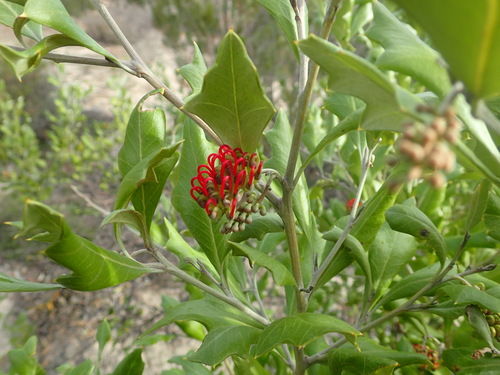
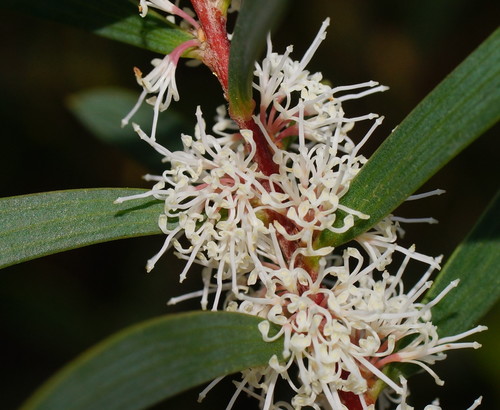
Hakea repullulans, commonly known as furze hakea, is an erect shrub that reaches 1.2 to 4 meters (4 to 10 feet) in height. It resprouts from a lignotuber, and often produces suckers from its horizontal roots. Its branchlets are densely covered with short, soft, matted hairs, and become hairless and smooth by the time flowering occurs. Leaves range from narrowly egg-shaped to long and narrow, twisted at the base, measuring 4 to 14 centimeters (2 to 6 inches) long and 3 to 12 millimeters (0.1 to 0.5 inches) wide. The leaves typically have 3 to 5 prominent longitudinal veins on both their upper and lower surfaces. Each inflorescence holds 10 to 36 cream-white flowers that grow in the leaf axils. Flowering occurs mostly in spring. The fruit of this species is obliquely egg-shaped, slightly curved toward its apex, measuring 1.5 to 2.6 centimeters (0.6 to 1 inch) long and 0.8 to 1.3 centimeters (0.3 to 0.5 inches) wide, tapering to a small beak. This species is distributed from southeastern South Australia to Grampians National Park and western regions of Victoria, eastward to the Otway Ranges, and also occurs near Sale in South Gippsland. It grows in acidic sandy soil within sclerophyll forests, and forms scattered populations in mallee-heath habitats.