About Hakea nodosa R.Br.
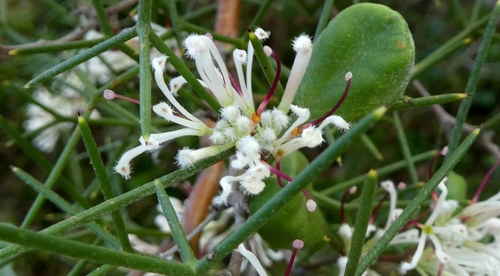
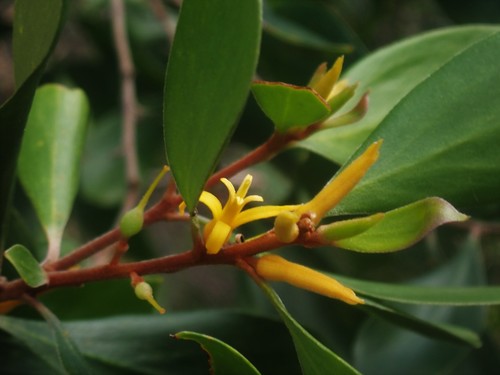
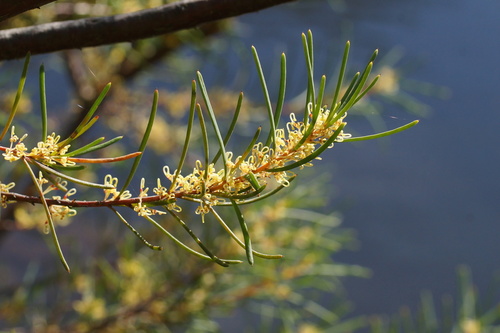
Hakea nodosa (common name yellow hakea) is an erect, sprawling shrub that typically reaches 3 metres (9.8 feet) in both height and width. Its branchlets develop distinct ribbing quickly, or become smooth over time. The leaves are most often needle-shaped, sometimes flattened, and flexible, measuring 0.8–5 cm (0.31–1.97 in) long and 0.7–2.5 mm (0.028–0.098 in) wide. Leaves are occasionally grooved on the lower surface, are smooth overall, and end in a sharp point 0.2–0.9 mm (0.0079–0.0354 in) long. It produces abundant inflorescences holding 2 to 11 cream-white to golden yellow flowers, clustered along branches. Each inflorescence grows from a simple stem that is densely covered in upright hairs, which may be white, brown, or a mix of the two. The pedicels are 1–1.5 mm (0.039–0.059 in) long and covered in soft, silky white hairs. The pistil is 3–4.5 mm (0.12–0.18 in) long, and the smooth perianth measures 1.3–2.2 mm (0.051–0.087 in) long. After flowering, the plant produces woody seed capsules 30 to 35 mm long. Two distinct forms of these capsules develop: one is woody with contrasting lighter raised bumps, while the other is smooth, non-woody, and opens while still attached to the branch. Flowering takes place from May to August. Yellow hakea is distributed in south-eastern South Australia, Victoria, and north-eastern Tasmania, where it grows in dense heath woodlands, most commonly in locations that are wet during winter on clay soil. In cultivation, yellow hakea adapts to a wide range of soils and climatic conditions, and grows well in both full sun and partial shade.