About Hakea gibbosa (Sm.) Cav.
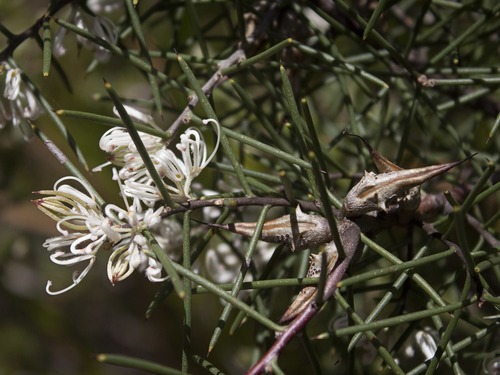
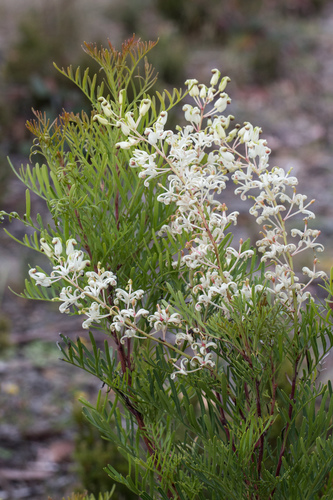
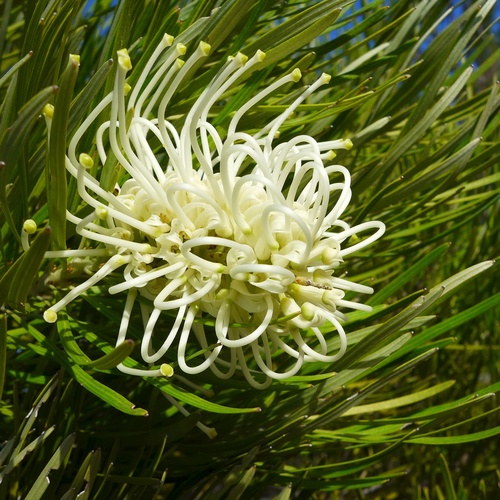
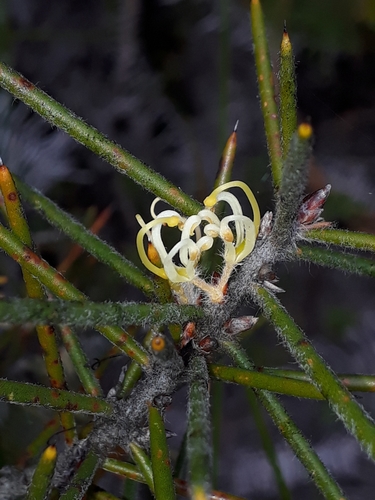
Hakea gibbosa (Sm.) Cav. is a very prickly shrub that grows 0.9–3 m (2 ft 11 in – 9 ft 10 in) tall. It can have a bushy or slender growth form, and it does not develop a lignotuber. New growth and young leaves are thickly covered with fine brown hairs, which become smooth as the plant ages. Its leaves are needle-shaped, mostly grooved on the underside, 2.5–8.5 cm (0.98–3.35 in) long and 0.9–1.5 cm (0.35–0.59 in) wide. Leaves spread in multiple directions, and end in a very sharp tip 1–2.3 mm (0.039–0.091 in) long. The inflorescence holds two to six individual cream-coloured flowers, borne on a 0.7–1.6 mm (0.028–0.063 in) long stem in the leaf axils. The flower pedicels are 2–5 mm (0.079–0.197 in) long and covered with long, soft hairs. Flowering takes place from April to July. The perianth is 5–6 mm (2.0–2.4 in) long, white to yellow, and usually smooth. The plant produces large, grey, globular, woody fruits that are 2.5–4.5 cm (0.98–1.77 in) long and 2–3 cm (0.79–1.18 in) wide. Fruits have a deeply wrinkled or warty surface, a small beak, and fragile horns around 0.3 mm (0.012 in) long. Each fruit contains two seeds, and fruits remain attached to the shrub. This species, commonly called needlebush hakea, is restricted to the Sydney basin in central New South Wales, where it grows on sandstone ridges and cliffs in heathland. It occurs alongside Corymbia gummifera (red bloodwood), Leptospermum trinervium (tea tree), Hakea teretifolia (dagger hakea), Banksia ericifolia (heath banksia), and Petrophile pulchella (conesticks). Plants previously classified as Hakea gibbosa found in Queensland have been reclassified as the new species Hakea actites. Hakea gibbosa is listed as a Category 1 Plant on the Declared Weeds & Invaders list for South Africa, and has become naturalised in northern parts of the North Island, New Zealand. In ecology, small birds use the dense prickly foliage as shelter, and the yellow-tailed black cockatoo eats the plant’s seeds. Hakea gibbosa adapts readily to cultivation and is easy to grow when provided with good drainage and a sunny position, though its very prickly foliage may deter gardeners from growing it. In 1999, the plant’s gum was investigated for use in sustained-release tablets.