About Hakea ferruginea Sweet
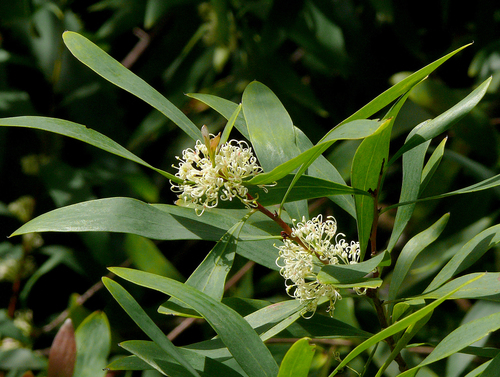
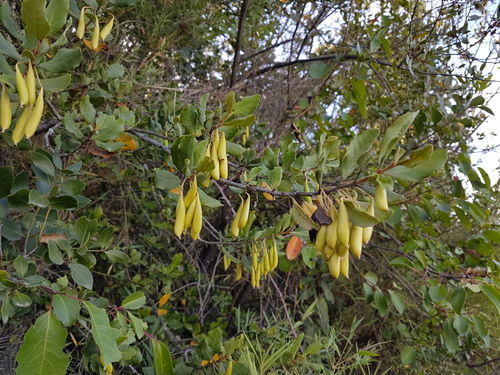
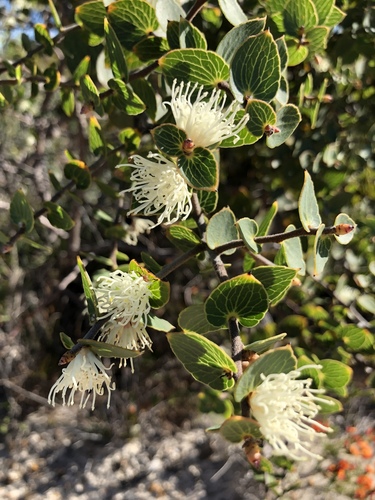
Hakea ferruginea Sweet, also commonly called rusty hakea, is an erect, rounded, non-lignotuberous shrub that usually grows to between 1 and 4.5 metres (3 to 15 ft) tall. Its branchlets are covered in hairs, and its leaves grow in an alternate arrangement. The leaf blade is pale green, flat, and ranges from narrowly to broadly egg-shaped or elliptic in form; it measures 1.5 to 8.5 centimetres (0.6 to 3.3 in) long, and 1.2 to 2.7 cm (0.47 to 1.06 in) wide. This species blooms between July and November, producing white-cream flowers. Its solitary inflorescences hold 16 to 20 flowers, each with a cream-white perianth. After flowering finishes, it forms obliquely ovate, beaked fruit that are 2 to 3.1 cm (0.79 to 1.22 in) long and 1.1 to 1.8 cm (0.43 to 0.71 in) wide. Inside the fruit are black to brown seeds that have a narrowly ovate or elliptic shape, with a wing running along one edge. Rusty hakea is distributed across a small area in the Wheatbelt, and along the south coast of the Great Southern and Goldfields-Esperance regions of Western Australia. It grows in sandy, rocky loam or clay soils, and is commonly a member of mallee heath or open forest plant communities.