About Hakea eriantha R.Br.
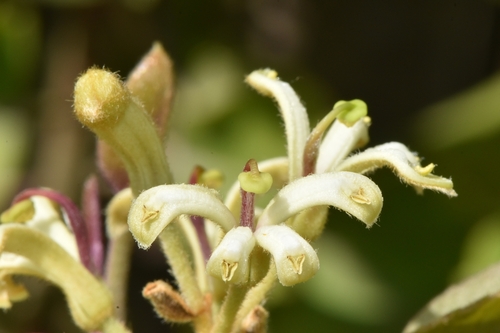
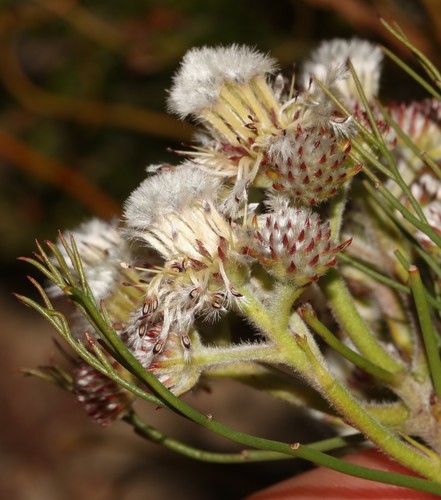
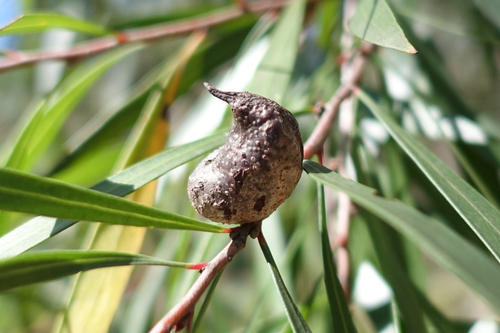
Hakea eriantha R.Br. is a dense, non-lignotuberous shrub or small tree, growing 1–5 m (3.3–16 ft) tall. Its leaves range from linear to egg-shaped, measuring 8 to 18.5 cm long and 1 to 30 mm wide. Young leaves are either smooth or covered with flattened fine hairs, and end in a sharp short point 0.5–1.5 mm (0.020–0.059 in) long. The inflorescence holds 6 to 10 cream flowers on a stalk about 2.5–3.5 mm (0.098–0.14 in) long, and grows in leaf axils. The pedicel is 2.5–6 mm (0.098–0.24 in) long, densely covered in soft white hairs that extend onto the lower part of the flower. The white perianth is 3.5–6.5 mm (0.14–0.26 in) long, and the style is 7–8.5 mm (0.28–0.33 in) long. Flowering occurs between August and November. The woody fruit is 1.9–3.2 mm (0.075–0.13 in) long and about 1.2–1.6 mm (0.047–0.063 in) wide. It has brown blister-like protuberances, ends with a short sharp point 3.5–4.5 mm (0.14–0.18 in) long, has a wrinkled texture, and features a beak about 3 mm long. This species, commonly called tree hakea, occurs in Eucalyptus woodland or forest, and at rainforest edges, ranging from Gladstone in Queensland southward to Gippsland in Victoria. In horticulture, Hakea eriantha is a fast-growing species, suitable for wet cold climates, and used as a screening or hedging plant. It acts as a food source for the gang-gang cockatoo (Calocephalon fimbriatum), as the two species share a similar habitat. It is also a preferred food source for the yellow-tailed black cockatoo (Calyptorhynchus funereus) in some districts.