About Hakea epiglottis Labill.
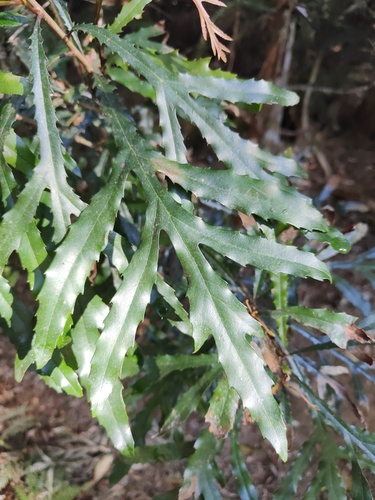
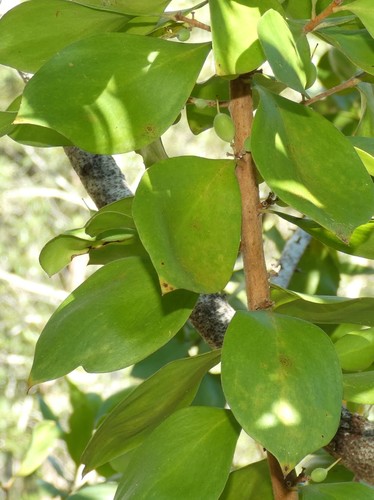
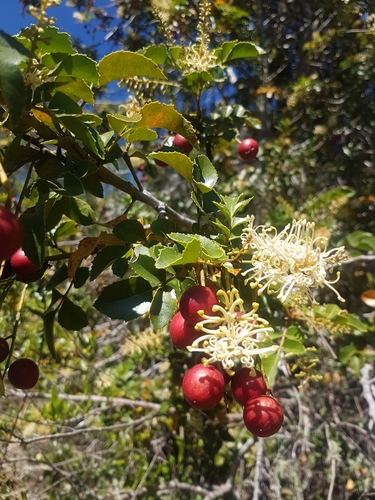
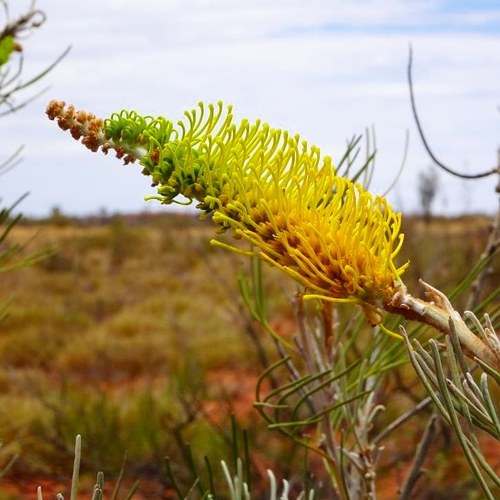
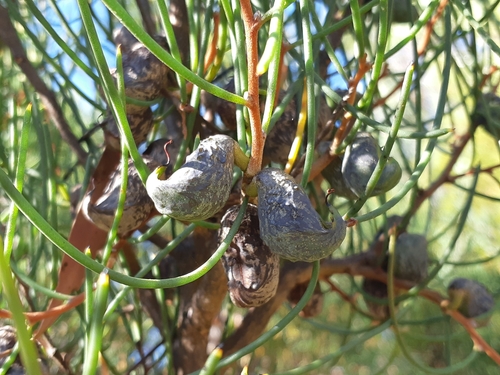
Hakea epiglottis Labill. typically grows to 3 metres (10 feet) tall. This species has needle-like leaves that are 1.5 to 11 centimetres (0.6 to 4 inches) long and 1 to 2 millimetres (0.04 to 0.08 inches) wide. Young leaves are covered in rust-coloured hairs, a trait that distinguishes Hakea epiglottis from the similar species Hakea megadenia. It is a dioecious species with unisexual flowers, and populations can consist of entirely unisexual individuals or bisexual individuals. In unisexual populations, male plants produce pollen-bearing flowers and do not produce fruit, while female plants produce fruit and do not produce pollen. Bisexual populations have plants that produce both fruit and pollen-bearing flowers. The inflorescence of male plants holds 2 to 8 flowers, while inflorescences on female plants hold 1 to 3 flowers. Bracts measure 3 to 4 millimetres (0.3 to 0.4 centimetres) long, growing from a stem that is about 1 millimetre (0.04 inches) long. Flower stems are 3.5 to 5 millimetres (0.4 to 0.5 centimetres) long and covered in flat white silky hairs that extend onto the sepals. Sepals are 2.5 to 4 millimetres (0.1 to 0.2 inches) long and pale yellow on the inside. The recurved pistil is 5.5 to 6.5 millimetres (0.2 to 0.3 inches) long. The style bears a small pollen disc, which is concave in male flowers, but has a conical protuberance in female flowers. After flowering, plants produce S-shaped fruits that are 1.4 to 2.6 centimetres (0.6 to 1 inch) long. Clusters of flowers ranging in color from white to bright yellow appear in leaf axils during spring. A 1989 publication by John Wrigley and Murray Fagg notes that specimens grown at Wakehurst Place, an annexe of London's Kew Gardens, are believed to be 60 to 70 years old, and measure 3 metres (9.8 feet) high and wide. Hakea epiglottis is a common species that is found in all parts of Tasmania except the north-east coast, where it grows in peaty heath.