About Hakea drupacea (C.F.Gaertn.) Roem. & Schult.
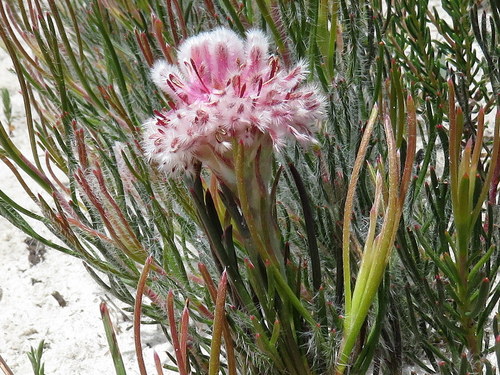
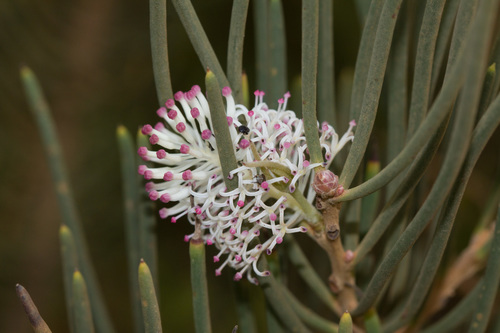
Hakea drupacea is an upright, rounded shrub that reaches a height of 1–4 m (3–10 ft). Its smaller branches have a hairy covering. The smooth, needle-shaped leaves grow in an alternate arrangement, measuring 4–11 cm (1.6–4.3 in) long and 1–2 mm (0.039–0.079 in) wide, and end in a sharp point. Individual leaves may divide into 2 to 8 segments. The inflorescences are short racemes made up of sweetly scented white or cream flowers, tipped with pink or brownish pollen. The pedicel is 4–8 mm (0.16–0.31 in) long, while the perianth is 4–5 mm (0.16–0.20 in) long and has a smooth surface. The smooth style measures 4–6 mm (0.16–0.24 in) long. Abundant flowers grow in outer leaf axils, blooming from March to June. The woody, egg-shaped fruit of Hakea drupacea is 20–25 mm (0.8–1 in) long and 15–19 mm (0.6–0.7 in) wide. The fruit surface is smooth, marked with a small number of black pustules, and ends in two prominent horns that are 2–4 mm (0.079–0.16 in) long. Sweet-scented hakea is primarily a coastal species, occurring between Albany and east of Cape Arid, and on the Recherche Archipelago Islands. The species is naturalised in South Africa, where it is called soethakea (meaning "sweet hakea"), New Zealand, and coastal Victoria. It grows in open heath or low shrubland areas on granite hillsides, and is occasionally found on quartzite areas or coastal limestone cliffs.