About Hakea dactyloides (C.F.Gaertn.) Cav.
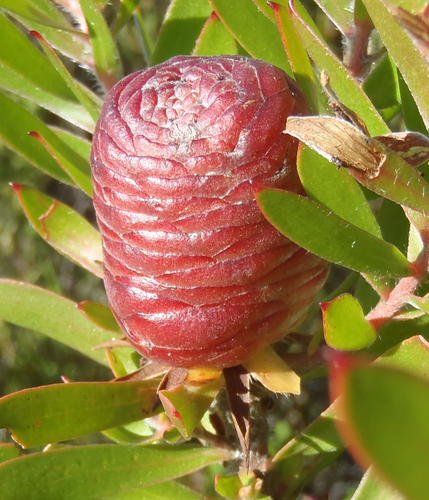
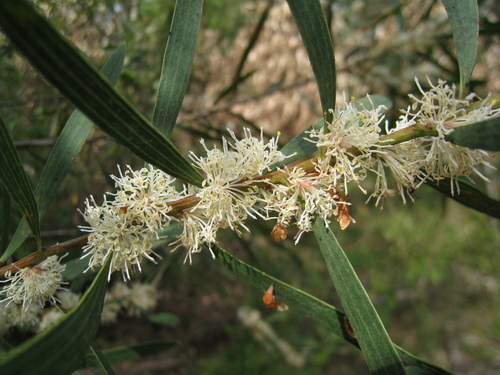
Hakea dactyloides (C.F.Gaertn.) Cav. is a non-lignotuberous, upright, single-stemmed bushy shrub or small tree that grows 2.4–4.5 m (8–10 ft) tall. Its small branches are smooth, generally pale, and covered with short matted fine hairs when the plant is flowering. Leaves are long and narrow, widest at the middle; they are rarely narrowly egg-shaped or sickle shaped, and measure 3.9–13 cm (2–5 in) long and 5–14.5 mm (0.2–0.6 in) wide. The mid-green leaves taper to a point, and have three prominent longitudinal veins on both their upper and lower surfaces. Solitary inflorescences hold 20–38 white flowers on a short stalk covered with flat, silky white hairs; rust-colored hairs are rarely present on the stalk. The sepals and petals are cream-white, and the style measures 4–6.5 mm (0.2–0.3 in) long. Fruit are warty, egg-shaped, slightly curved, 2.5–3.5 cm (1–1 in) long and 1.7–2.3 cm (0.7–0.9 in) wide, ending in a sharp short point. Small white flowers, often with a pink tinge, appear in axillary clusters along branches from October to November. This is a widespread species found on the Central Coast, South Coast, and Tablelands of New South Wales, including the Central Western Slopes, as well as in north-eastern Victoria. Hakea dactyloides grows on slopes, ridges, and along watercourses on sandstone in sclerophyll forest. It is a hardy, quick growing species tolerant of most growing situations.