About Hakea cristata R.Br.
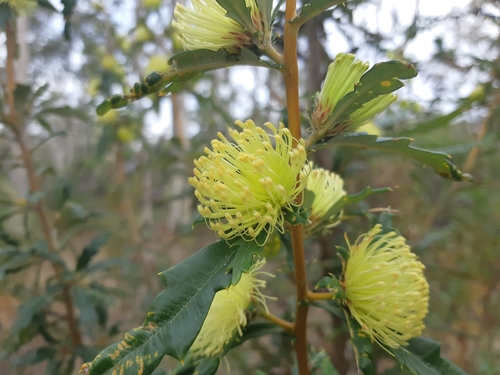
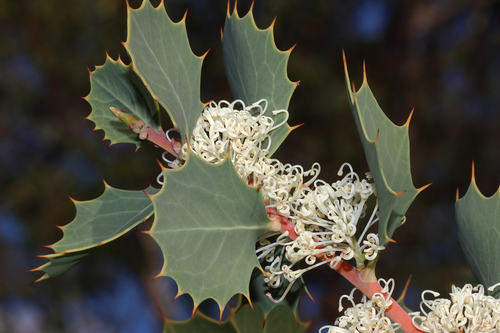
Hakea cristata R.Br., commonly called snail hakea, is a straggly, upright, multi-stemmed shrub that typically grows 1 to 3.5 metres (3 to 11 ft) tall. Its smaller branches have a smooth surface. Leaves grow alternately on branches, are more or less egg-shaped tapering toward the base, and measure 4.5 to 8 centimetres (1.8 to 3.1 in) long and 2 to 5 cm (0.8 to 2.0 in) wide. Leaf margins are toothed and prickly, while new smooth growth has an attractive pink-reddish colour. Mature smooth mid-green leaves have a central vein that ends in a stiff sharp point. Each inflorescence, which forms in upper leaf axils between May and August, contains 24 to 42 faintly scented cream-white flowers. The perianth of the flower is 2 to 4 mm (0.079 to 0.157 in) long and smooth, and the style is also smooth. The fruit of this species is what distinguishes it, with a toothed crest running along each side of the underside of the fruit valve, ending in a triangular horn at the apex. Fruit grows at an angle on the stalk, is egg-shaped, and measures 3.5 to 5 cm (1.4 to 2.0 in) long and 2.3 to 3 cm (0.91 to 1.18 in) wide. The fruit surface has spiky toothed ridges, and fruit may stay green even when fully mature. The winged elliptic seeds are 3 to 3.4 cm (1.18 to 1.34 in) long. This species is found exclusively on lateritic soils and granite outcrops in the jarrah forests of the Darling Scarp, between Chittering and Mundaring, where it usually grows as part of open Eucalyptus wandoo woodland communities.