About Hakea carinata F.Muell. ex Meisn.
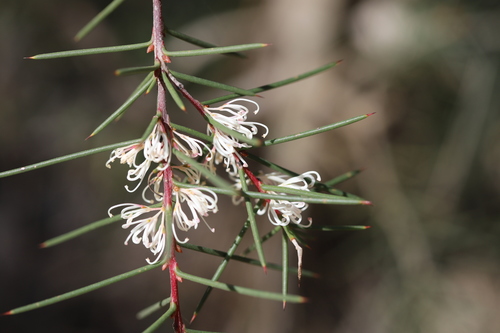
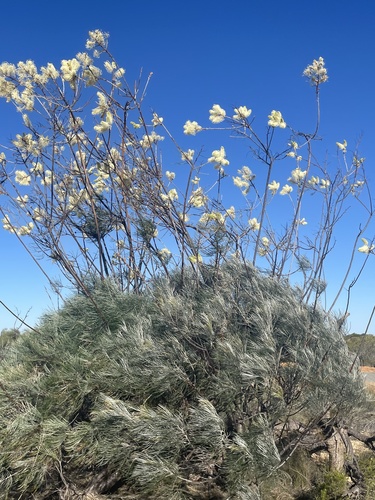
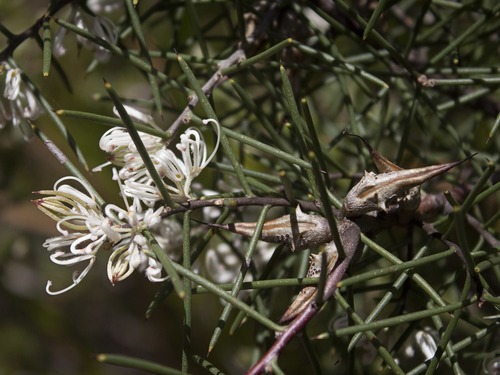
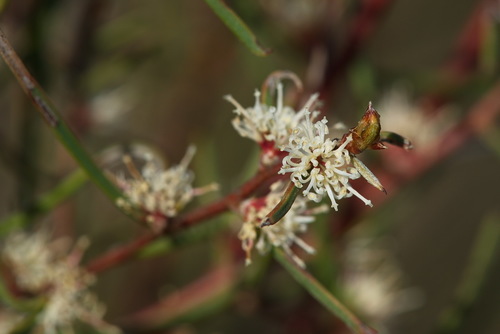
Hakea carinata F.Muell. ex Meisn. is an erect shrub that typically grows 1.5 to 3 metres (4.9 to 9.8 ft) tall. Its flexible leaves are smooth, flat and linear, with a concave or triangular cross-section. Leaves measure 5 to 24 centimetres (2 to 9 in) long and 1 to 12 millimetres (0.0 to 0.5 in) wide, and have prominent marginal veins. Smaller branches are covered in fine, flattened hairs at flowering time, and are sometimes smooth. Single inflorescences, made up of 8 to 24 cream-white flowers, grow in leaf axils. The pink pedicels are smooth, and sometimes bear thinly scattered silky hairs. The perianth is cream-white, and the style is 3 to 6 millimetres (0.118 to 0.236 in) long. Fruits are attached to a short stem, and are narrowly oblong to egg-shaped. They measure 1.3 to 2.6 cm (0.51 to 1.02 in) long and 0.6 to 1.1 cm (0.24 to 0.43 in) wide, with a long, narrow, straight or slightly curved beak pointing toward the apex. Blackish-brown seeds are narrowly oblong to egg-shaped, 1.0 to 1.8 cm (0.39 to 0.71 in) long and 4 to 6.5 mm (0.157 to 0.256 in) wide, with a wing on each side. This species flowers in spring, from September to October. This hakea has a scattered distribution across the southern parts of the Flinders Range and the Mount Lofty Ranges. A small number of isolated populations also occur in the southeast of the state around Padthaway. Hakea carinata is often part of the understorey in dry sclerophyll forest, and also grows in scrub-heath communities. It grows in sandy to loamy soils.