About Haemorhous cassinii (S.F.Baird, 1854)
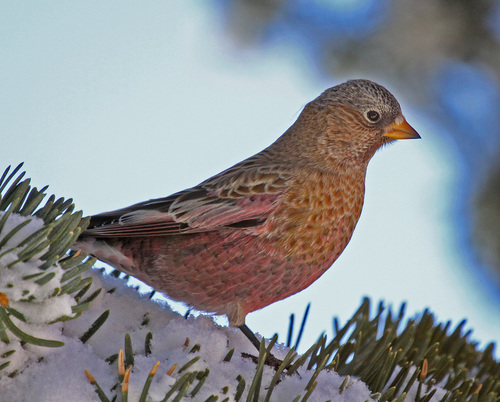
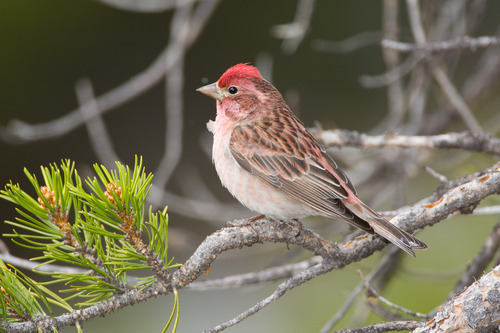
This species has the scientific name Haemorhous cassinii (S.F.Baird, 1854). Measurements: length 6.3 in (16 cm), weight 0.8–1.2 oz (24–34 g), and wingspan 9.8–10.6 in (25–27 cm). Adults have a short, forked brown tail and brown wings, with a longer bill than the purple finch. Adult males have raspberry red coloring on the head, breast, back, and rump, with streaked backs and undertail areas. Adult females have light brown upperparts and light underparts with brown streaks across the body, and their facial markings are less distinct than those of female purple finches. Individuals of this species can have brown, red, or white eyes. Their breeding habitat is coniferous mountain forest in western North America, ranging as far south as northern New Mexico and Arizona; they also breed in Southern California near Baja California. They nest in large conifers. In winter, they move to lower elevations. The northernmost breeding birds migrate south, and some birds across the species' entire range also migrate; however, many individuals are permanent residents. Some non-breeding birds winter as far south as central interior Mexico. Nests are usually built in large conifer trees, though deciduous trees are occasionally used. Nesting can also happen in human-modified habitats such as farmlands. The nest is shaped like an open cup, and can be constructed from sticks, weeds, roots, bark, grass, plant fibres, animal hair, and lichens. The female typically lays 4 to 5 eggs at a time, clutch sizes can range from 3 to 6 eggs. The eggs are bluish green with brown and black spots. Incubation is done by the female, and lasts approximately 12 to 14 days. Both parents feed the nestlings, and the young leave the nest around 2 weeks after hatching.